Why 80% of AI Projects Fail (And the 4 Things That Make the 20% Succeed)
The research tells the story in aggregate, but it plays out the same way in individual organizations everywhere: a technical team builds something that works beautifully in testing, and the people who were supposed to use it keep using their spreadsheets. Nobody asked the operations team whether they trusted it, understood it, or had any reason to adopt it. The "AI project" was a technology project from day one, handed off to a business team that had never been part of building it.
That pattern isn't unusual. It's the norm.
I'm new to AI consulting as a client-facing practice, and I'll be direct about that. What I bring is 30 years of building real systems: founding adoption.com in 1995 while at Cap Gemini, helping businesses develop internet strategy before Google existed; managing humanitarian operations across Ethiopia, Kenya, Haiti, and three other countries; overseeing programs where a failure in the system wasn't an embarrassing slide deck moment, it was a child who didn't get what they needed. And I've built AI agents and web apps hands-on using Claude Code and Codex, so I know what implementation actually involves, not just what the slide decks say. That background gives me a particular allergy to systems that look good on paper and collapse in the field.
AI is experiencing that collapse at scale right now, and the data is stark.

The Failure Rate Is Real, and It's Getting Worse
Let's start with the numbers, because the headlines are genuinely alarming.
The RAND Corporation published a study in August 2024 based on interviews with 65 experienced data scientists and engineers. Their finding: more than 80% of AI projects fail to deliver their intended business value, roughly twice the failure rate of comparable IT projects that don't involve AI. [1]
MIT's NANDA initiative found something even more troubling. After surveying 350 employees, conducting 150 executive interviews, and analyzing 300 public AI deployments, they concluded that approximately 95% of enterprise generative AI pilots failed to deliver measurable P&L impact. The report, titled "The GenAI Divide: State of AI in Business 2025," was covered prominently in Fortune in August 2025. [2]
Then there's S&P Global Market Intelligence, which surveys over 1,000 midlevel and senior IT professionals across North America and Europe each year. Their 2025 Voice of the Enterprise report found something that should shock any CFO: the percentage of companies abandoning most of their AI initiatives before they reach production jumped from 17% in 2024 to 42% in 2025. [3] That's not a slow drift. That's organizations slamming the brakes after burning real money.
McKinsey's 2025 Global AI Survey of 88% adoption tells a similarly sobering story from the other direction: 88% of organizations now use AI in at least one function, but only 39% report any EBIT impact at all. And of those, most attribute less than 5% of their EBIT to AI. Only 6% of respondents qualify as genuine AI "high performers" with meaningful financial results. [4]
Gartner surveyed 782 infrastructure and operations leaders in late 2025 and found that only 28% of AI use cases fully succeeded and met ROI expectations. 20% failed outright. And 57% of leaders who reported failures said their projects failed because they "expected too much, too fast." [5]
I'll be direct: we are in the middle of one of the most expensive misallocations of enterprise investment in recent memory. And the failure isn't coming from the technology. The technology works. The failure is coming from how organizations deploy it.
Why the Failure Rate Is So High: 4 Root Causes

I'm a medical technologist by background. Before I became an internet entrepreneur, I was trained to find the root cause, not treat symptoms. When I look at the AI failure data from RAND, MIT, McKinsey, Gartner, and S&P Global, the same four root causes show up in every study. They're not technical. They're structural.
Cause 1: The Problem Was Never Actually Defined
RAND's research identifies "misunderstanding the problem" as the leading root cause of AI project failure. The finding from their 65 interviews was specific: industry stakeholders often "misunderstand or miscommunicate what problem needs to be solved using AI," resulting in models that have been "optimized for the wrong metrics or do not fit into the overall business workflow and context." [1]
I see this constantly. An organization decides they want to "use AI for customer service." That's not a problem definition. That's a technology decision in search of a problem. The right question is: what specific, measurable customer service outcome are we trying to move? Call resolution time? First-contact resolution rate? Cost per ticket? Customer satisfaction score? And what does the data look like for that specific outcome right now?
When the problem isn't defined precisely, nobody can agree on what success looks like. The data team builds toward one target. The business team expects a different outcome. And when the system is delivered, everyone is disappointed by something slightly different.
The companies in the 20% that succeed don't start by asking "what AI should we use?" They start by asking "what specific decision do we make over and over that we'd make better with more intelligence?" That question sounds boring. But it's the difference between an 18-month project that gets ignored and one that gets used every day.
Cause 2: The Data Wasn't Ready
If there's one thing the research agrees on across all studies, it's this: dirty, fragmented, or inaccessible data is the single biggest technical contributor to AI failure.
Informatica's 2025 survey puts data quality and readiness at the top of the list of obstacles to AI success, cited by 43% of respondents, tied with lack of technical maturity. [6] A Capital One survey of enterprise data leaders found that 73% identified "data quality and completeness" as the primary barrier to AI success. [7] Gartner predicts that 60% of AI projects lacking AI-ready data will be abandoned entirely before 2026 ends. [5]
Here's what "not AI-ready" actually looks like in practice. I've talked with organizations where:
- Customer data lives in four different systems that don't talk to each other, with different customer IDs in each one
- Historical transaction data is stored in formats that are technically readable but haven't been consistently coded for years
- The "data" needed for the model exists in PDFs and emails, not structured databases
- Key fields have 30-40% missing values that nobody ever bothered to fix because humans filled in the gaps manually
You can't train a model on data like that and expect it to work. You can't deploy a model trained on clean historical data into a production environment full of messy real-world data and expect it to behave the same way. The model is only as good as what you fed it.
The honest truth is that most organizations need a significant data infrastructure investment before they're ready for AI. That's not a fun conversation to have with a leadership team that wants to move fast. But organizations that skip it are buying themselves expensive failure. Data quality issues are responsible for, by some estimates, 70% of pilot failures. [6]
Cause 3: Nobody Managed the Human Side
I ran orphanages on three continents. I've worked in cultures as different from each other as Ethiopia and Mexico, Haiti and England. And at Cap Gemini in the 1990s, I watched organizations resist the internet the same way organizations resist AI today: not because the technology was bad, but because nobody brought the humans along. The one constant across every country, every system, every organization I've worked with: you cannot implement a process change without that piece.
AI is a process change. It changes how people work. And the research is clear that most organizations aren't treating it that way.
Only about one-third of companies in late 2024 said they were prioritizing change management and training as part of their AI rollouts. [8] That means roughly two-thirds deployed AI systems and hoped people would figure it out on their own.
That didn't work with the internet in 1998 and it doesn't work with AI in 2026.
The MIT NANDA report found something interesting on this front: purchasing AI tools from specialized vendors and building partnerships succeeded about 67% of the time, while internal builds succeeded only one-third as often. [2] Part of that gap is technical expertise. But part of it is that specialized vendors have done this before and know that adoption is an outcome, not an accident.
When the manufacturing company I mentioned at the start deployed their demand forecasting system, the operations team didn't trust it. They hadn't been part of the requirements process. They didn't understand how it worked. They couldn't explain to their supervisors why the system was recommending what it was recommending. So they ignored it. A $2.3 million investment in a tool nobody used.
Change management isn't soft work. It's the work that determines whether the technical work delivers any value at all.
Cause 4: Nobody Was Accountable After Launch
This is the one that most organizations don't talk about, so I'll say it plainly: the majority of AI projects that technically "succeed" still fail to deliver value because nobody owns them after the project team ships and moves on.
Research cited in 2025 found that 41% of underperforming AI projects suffered from "AI without a home," where technically delivered projects were never operationally adopted because no clear owner existed to drive adoption, resolve conflicts, or iterate on performance. [9]
MIT Sloan research found that 61% of enterprise AI projects were approved based on projected value that was never formally measured after deployment. Executives approved the investment, the project was delivered, and then everyone moved on to the next initiative without establishing any measurement infrastructure to know whether it worked. [9]
That pattern is especially damaging because AI systems degrade. The world changes. Customer behavior shifts. Supply chains evolve. An AI model trained on 2023 data running in 2026 without any monitoring or retraining is quietly becoming less accurate every month, and nobody's watching.
Only 28% of CEOs take direct personal responsibility for AI governance oversight. Only 17% of corporate boards formally own it. [9] That means AI systems making pricing decisions, credit decisions, HR screening decisions, and customer communication decisions are running inside organizations where four out of five have no clear chain of accountability at the top.
You wouldn't run your finance function without someone accountable for it. You shouldn't run your AI systems that way either.
The 4 Things That Make the 20% Succeed
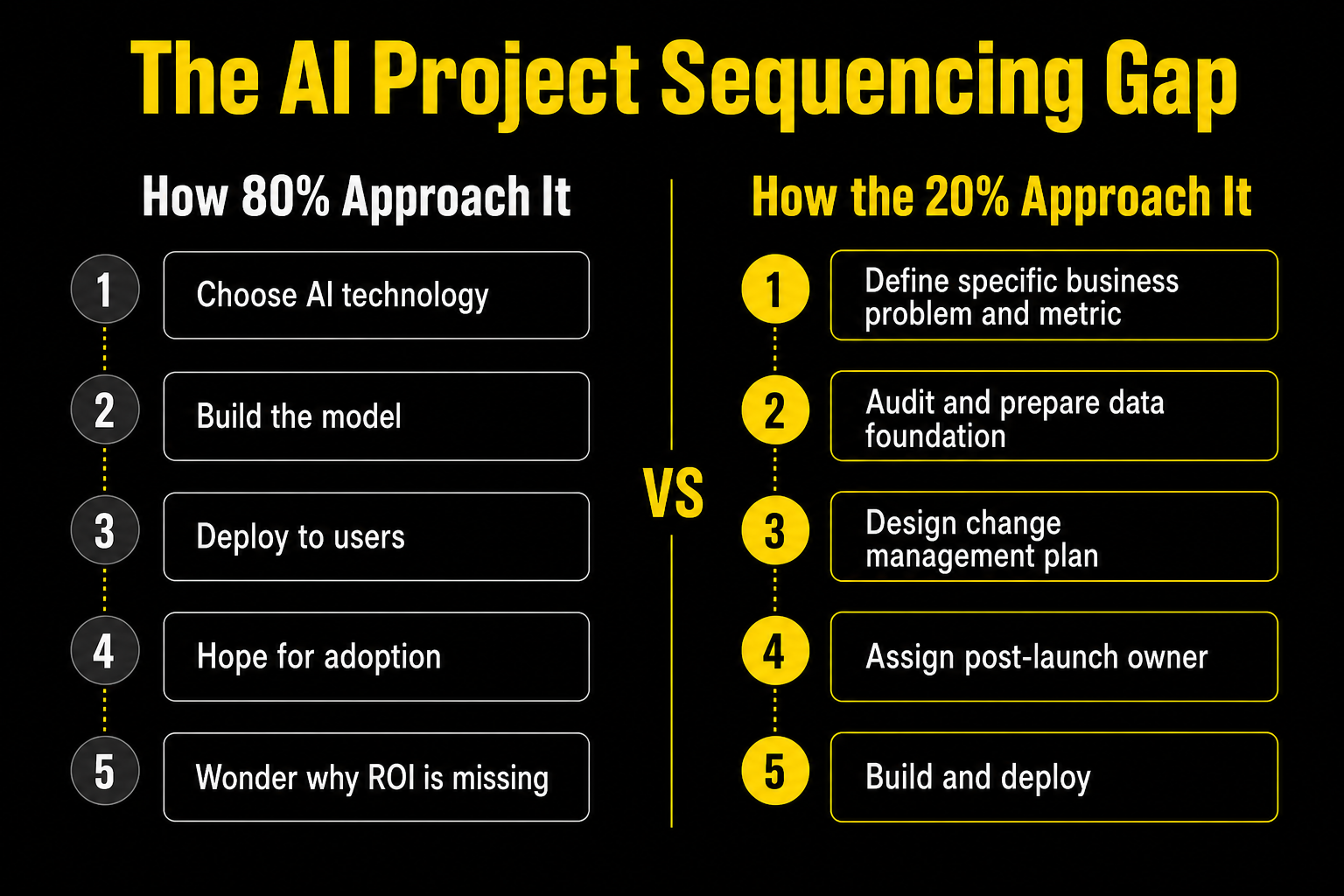
I don't only study failure. I study what works. And the research on the 20% that succeed is just as consistent as the research on the 80% that don't.
Stanford's HAI published research in 2026 studying 51 successful AI deployments across 41 organizations. Their conclusion: the companies that succeed "don't necessarily have better AI tools, larger budgets, or stronger data science teams." They follow a different sequence. They start with organizational readiness rather than technology selection. [10]
That's the signal buried in all of this failure data. It's not a technology problem. It's a sequencing and structure problem.
Success Factor 1: Problem-First, Not Technology-First
The 20% start with a specific business problem that has a measurable outcome, a clear decision that needs improving, and actual data that can be used to improve it. They don't start by deciding they want to use a large language model or implement machine learning or "leverage AI."
The language matters. "We want to use AI" is a technology decision. "We want to reduce the time our loan officers spend reviewing applications that are obviously unqualified, from 45 minutes average to under 10, without increasing error rates" is a problem definition that can be solved.
When you start with the specific problem, you can evaluate whether AI is actually the right tool. Sometimes it isn't. Sometimes a better-designed workflow, a cleaner data system, or a simpler rule-based filter will solve the problem faster, cheaper, and more reliably. Starting with the problem keeps you honest.
Success Factor 2: Data Infrastructure Before Model Development
The 20% invest in their data foundation before they try to build models on top of it. That means data pipelines, data governance, data quality monitoring, and data documentation. It's unglamorous work. It rarely makes it into a board presentation. But it's the work that determines whether anything else is possible.
Stanford's 2026 research found that scalable infrastructure and quality data were among the most consistent markers of successful AI deployments. [10] McKinsey found that the single strongest correlation with EBIT impact from AI was fundamental workflow redesign, not model sophistication. [4] In other words, the organizations getting results from AI aren't the ones with the fanciest models. They're the ones with the cleanest systems and the clearest processes.
This is where my background as a medical technologist becomes relevant. In clinical laboratory science, you learn that your result is only as good as your sample. A perfect assay run on a contaminated specimen gives you a perfectly wrong answer. The AI equivalent is a sophisticated model trained on bad data. The output looks precise. The precision is false.
Success Factor 3: Change Management as a First-Class Deliverable
The organizations that succeed treat adoption as a product, not an afterthought. They involve end users in requirements. They run training that goes beyond "here's how to use the interface" to "here's how this changes your workflow and why it makes your job better." They measure adoption, not just deployment.
McKinsey's high-performer analysis found that high-performing organizations are three times more likely to have senior leaders who "demonstrate ownership and commitment to AI initiatives." [4] That ownership shows up in how they treat the people side. Senior sponsorship that's genuine rather than performative. Real investment in training. Honest communication about what will change and what won't.
I've managed operations in seven countries across cultures that are dramatically different in how people respond to change and authority. The one universal I've found is that people don't resist change when they understand why it's happening, were involved in shaping it, and feel confident they can succeed in the new system. That's not a cultural thing. That's a human thing.
Success Factor 4: Clear Ownership from Day One, Not Day 91
The MIT NANDA research found that buying AI from specialized vendors succeeded at roughly twice the rate of internal builds. [2] One underappreciated reason: vendors typically require a named internal owner as part of the engagement. There's a contract. There's a success definition. There's someone on the client side whose job depends on the thing working.
Internal projects often don't have that structure. The project team is borrowed from other functions and returns to them when the project ends. The model is deployed and technically "live," and then nobody quite owns what comes next.
The organizations in the 20% assign a product owner to every AI system before the first line of code is written. That person is accountable for measuring outcomes, managing the ongoing data quality, driving user adoption, and deciding when the model needs to be retrained or replaced. They exist at the intersection of the business need and the technical implementation, and they never disappear just because the project was "delivered."
What This Means If You're Considering an AI Investment
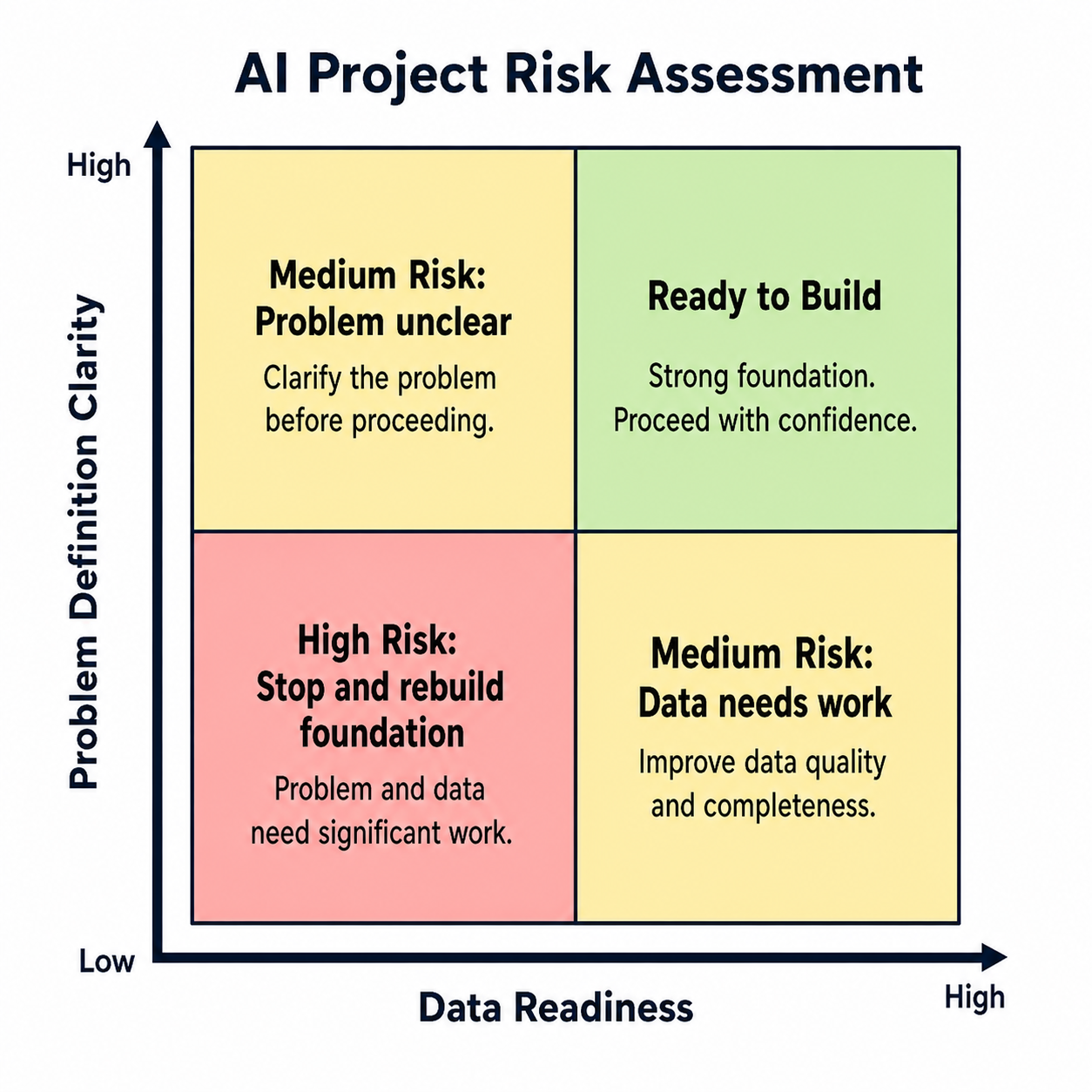
If you're reading this as a business leader evaluating whether to launch an AI initiative, here's my honest assessment after 30 years of building systems that have to work in the real world.
The failure rates are real. The $684 billion spent on AI in 2025 produced significant positive results for about 6% of organizations. [4] That's not a reason to avoid AI. It's a reason to approach it differently than most organizations do.
Before you start a new AI project, I'd ask four diagnostic questions:
Can you articulate the specific business decision this AI will improve, the metric that decision affects, and the current baseline for that metric? If you can't answer that in one sentence, you're not ready to build yet.
Do you have clean, accessible, consistently-coded historical data for the problem you're trying to solve? If the data lives in multiple systems, has significant missing values, or isn't regularly maintained, your first project is a data infrastructure project.
Who in the business has committed to the change management work? This isn't IT's job. It belongs to whoever owns the business function being changed.
Who will own this system after launch? Who is accountable for measuring whether it's working, keeping the data current, managing model drift, and making the call to retrain or retire it?
If you have clear answers to all four, you're in the 20%. If you're missing any of them, you know exactly where to focus before you spend another dollar on AI.
A Final Thought on Hype
I helped businesses adopt the internet before most people knew what it was, at Cap Gemini in the 1990s. I've watched "revolutionary technology" cycles long enough to have a sense of how they play out. The internet was genuinely revolutionary and also genuinely overhyped in 1999. Both things were true simultaneously.
AI is the same. The technology is real. The capability is real. The transformation that's coming for organizations that implement it well is real. And the carnage happening right now inside organizations that are chasing a trend without building the foundation is equally real.
I'm new to AI consulting as a practice. But I've built real systems in hard environments for 30 years, and I've been hands-on building AI agents and web apps using Claude Code and Codex. The principles that separate the 20% that succeed from the 80% that don't aren't new. They're the same principles that separated successful internet adoptions from failed ones in 1998.
The 20% that succeed aren't the ones who moved fastest or spent the most. They're the ones who asked better questions at the start, built on solid foundations, brought their people along, and stayed accountable for outcomes over time.
That's not a new principle. It's just good systems thinking applied to a new tool.
And it's exactly what separates the organizations that will be case studies in AI success from the ones that will be statistics in next year's failure rate research.
Sources
[1] RAND Corporation, "The Root Causes of Failure for Artificial Intelligence Projects and How They Can Succeed: Avoiding the Anti-Patterns of AI," https://www.rand.org/pubs/research_reports/RRA2680-1.html, 2024
[2] MIT NANDA Initiative / Fortune, "MIT report: 95% of generative AI pilots at companies are failing," https://fortune.com/2025/08/18/mit-report-95-percent-generative-ai-pilots-at-companies-failing-cfo/, 2025
[3] S&P Global Market Intelligence, "AI experiences rapid adoption, but with mixed outcomes , Voice of the Enterprise: AI & Machine Learning, Use Cases 2025," https://www.spglobal.com/market-intelligence/en/news-insights/research/ai-experiences-rapid-adoption-but-with-mixed-outcomes-highlights-from-vote-ai-machine-learning, 2025
[4] McKinsey & Company, "The State of AI: Global Survey 2025," https://www.mckinsey.com/capabilities/quantumblack/our-insights/the-state-of-ai, 2025
[5] Gartner, "Gartner Says AI Projects in I&O Stall Ahead of Meaningful ROI Returns," https://www.gartner.com/en/newsroom/press-releases/2026-04-07-gartner-says-artificial-intelligence-projects-in-infrastructure-and-operations-stall-ahead-of-meaningful-roi-returns, 2026
[6] Informatica / AI Data Analytics Network, "Data quality and availability top list of AI adoption barriers," https://www.aidataanalytics.network/data-science-ai/news-trends/data-quality-availability-top-list-of-ai-adoption-barriers, 2025
[7] Capital One / The Data Experts, "Enterprise AI Failure Rate: Why 95% of Projects Fail," https://www.thedataexperts.us/writing/enterprise-ai-failure-crisis-95-percent-failure-rate.html, 2025 (citing 2024 Capital One survey)
[8] Stack AI / IBM Think, "The Biggest AI Adoption Challenges for 2026," https://www.ibm.com/think/insights/ai-adoption-challenges, 2026
[9] AI Governance Today / MIT Sloan Management Review, "The Three Obstacles Slowing Responsible AI," https://sloanreview.mit.edu/article/the-three-obstacles-slowing-responsible-ai/, 2025
[10] Stanford Human-Centered AI (HAI), "Why Corporate AI Projects Succeed or Fail," https://hai.stanford.edu/news/why-corporate-ai-projects-succeed-or-fail, 2026
[11] Gartner, "Why Half of GenAI Projects Fail: Avoid These 5 Common Mistakes," https://www.gartner.com/en/articles/genai-project-failure, 2024
[12] CIO Dive / S&P Global, "AI project failure rates are on the rise: report," https://www.ciodive.com/news/AI-project-fail-data-SPGlobal/742590/, 2025