The Honest Case for NOT Hiring an AI Consultant (And When You Should)
Here's the advice I'd give any founder considering an AI consultant, including me: not yet, if you're not ready.
Imagine a founder who wants to automate her customer onboarding. She has a budget. She has a timeline. What she doesn't have is a documented onboarding process. At all. She knows roughly what her team does, but it's never been written down, standardized, or measured. Two consultants already took that project anyway.
The right answer is: not yet.
That's not a consultant talking herself out of a fee. That's thirty years of building systems that have to survive contact with reality talking. I worked at Cap Gemini in the 1990s, when "internet strategy" meant figuring out what the internet was before most people had email. I founded adoption.com in 1995 and ran operations across seven countries: the United States, Ethiopia, Kenya, Haiti, Mexico, China, and England. I ran orphanages on three continents, where systems didn't get the luxury of failing gracefully. And what I learned across all of that is this: technology doesn't fix broken processes. It accelerates them.
So before you hire anyone, including me, read this.

The Uncomfortable Truth About AI Consulting
The AI consulting market is growing fast, and a lot of people have set up shop in it. Rates currently run from $150 to $350 per hour for independent consultants, and $5,000 to $25,000 per project for SMB-scale engagements [1]. The pressure to hire someone is real. The FOMO is real. Your competitors are doing something with AI, and you feel it.
Here's what's also real: McKinsey's 2025 State of AI report found that while 88% of organizations now use AI in at least one function, only 39% report any EBIT impact at the enterprise level. Of those, most report less than 5% of their EBIT is attributable to AI. The true high performers, those getting more than 5% EBIT impact, represent roughly 5.5% of respondents [2].
Let that sink in. 88% adoption. 5.5% meaningful results.
Gartner predicted that at least 30% of generative AI projects would be abandoned after proof of concept by the end of 2025, driven by poor data quality, escalating costs, and unclear business value [3]. A separate Gartner analysis found that 60% of AI projects lacking AI-ready data would be abandoned through 2026 [4].
This isn't an indictment of AI. It's an indictment of premature AI. And a consultant who takes your money before you're ready is making your premature AI problem someone else's expensive failure.
I'm not willing to do that. So let's talk about when you're not ready.
When You Should NOT Hire an AI Consultant
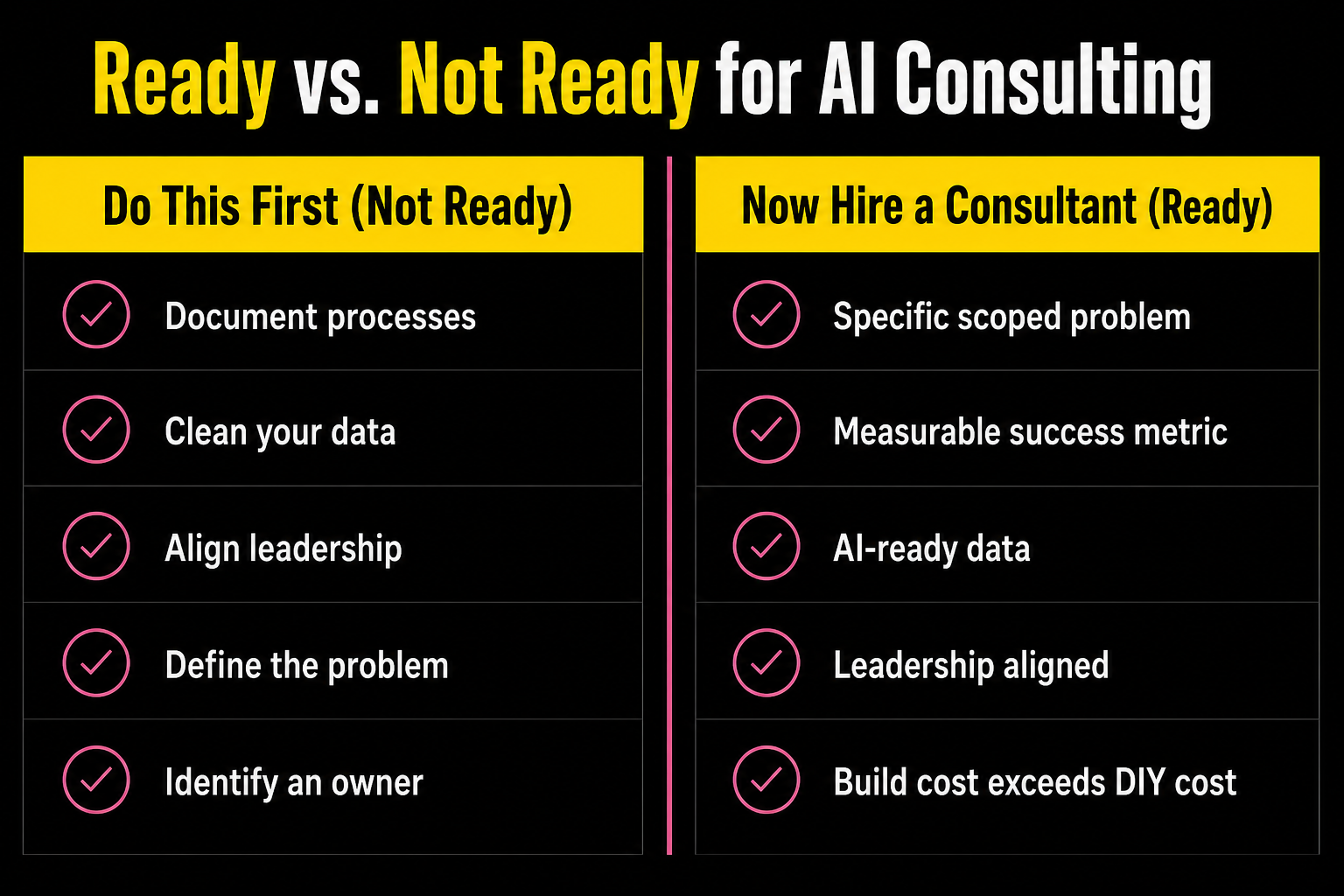
Your Processes Aren't Documented
This is the single biggest red flag I see, and it stops more projects than any technical limitation.
If you can't hand me a written description of the process you want to automate, with defined inputs, defined outputs, defined exceptions, and defined success criteria, then we don't have something to automate. We have a conversation about what your team generally does. You can't build reliable AI systems on top of "generally."
My background is medical technology. In a clinical lab, you don't run a test on a broken instrument and report the results as valid. You fix the instrument first. The same discipline applies here. Automating an undefined process doesn't give you a faster version of your current workflow. It gives you a faster version of your current chaos.
Before you spend a dollar on AI consulting, spend time documenting. Walk the process. Map every step. Count how many exceptions actually happen. You'll often discover that what you thought was a single workflow is actually four different workflows depending on who's doing it that day.
That clarity alone is worth more than any tool I could build you.
Your Data Is a Mess
This is the number-one technical killer, and the research is unambiguous about it.
Gartner reports that 85% of AI projects fail due to poor data quality or lack of relevant data [4]. IBM's Institute for Business Value found that only 29% of technology leaders strongly agree their enterprise data meets the quality, accessibility, and security standards needed to scale generative AI [5]. And a 2025 IBM survey of 1,700 senior data leaders found that 43% of chief operations officers identify data quality as their most significant data priority, with over a quarter of organizations losing more than $5 million annually to poor data quality [5].
What does "messy data" actually mean in practice? It means:
- Customer records spread across three CRMs and a spreadsheet nobody talks about
- Dates formatted four different ways in the same column
- Product names that changed twice and haven't been reconciled in older records
- Email lists that haven't been cleaned in two years
- Sales data where "closed" means different things to different reps
AI learns from your data. If your data is inconsistent, incomplete, or inaccurate, your AI system will be inconsistent, incomplete, and inaccurate at scale. The most sophisticated model in the world cannot learn patterns from noise.
The fix is not glamorous. It's data auditing, normalization, tagging, and governance. It's cleaning house before you buy new furniture. It's operations work, not AI work.
And it's almost certainly worth hiring an operations specialist before you hire an AI consultant.
Leadership Isn't Aligned
I can build you a beautiful system. If your leadership team doesn't understand what it does, why it's measuring what it measures, or how to respond when it surfaces a recommendation, it will collect dust.
McKinsey's 2025 research puts the problem bluntly: "The biggest barrier to scaling AI is not employees, who are ready, but leaders, who are not steering fast enough" [2]. Deloitte's research identifies C-suite alignment as a top-three predictor of scaling success [6]. Cisco's 2024 AI Readiness Index, which surveyed nearly 8,000 senior business leaders across 30 markets, found that while 98% of organizations report increased urgency to deploy AI, only 13% are fully ready to capture AI's potential, down from 14% the year before [7].
Read that again. Urgency went up. Readiness went down.
When I ask potential clients whether their leadership team has agreed on what problem they're solving with AI, I get a lot of hedging. "Well, the CEO is excited about it." That's not alignment. That's excitement. Alignment means the CEO, the ops lead, and the department head where the system will live all agree on:
- What problem we're solving
- What success looks like in measurable terms
- Who owns the output
- What changes when the system surfaces a result
If you can't answer those four questions in a 15-minute meeting with your leadership team, you're not ready.
You're Chasing the Trend, Not Solving a Problem
I get calls that start with some version of: "We need an AI strategy." When I ask what problem that strategy is meant to solve, I often hear: "We just need to be doing AI. Everyone else is."
That's not a business reason. That's FOMO. And consultants who take FOMO money are doing their clients a disservice.
The AI projects that deliver results share one characteristic: they start with a specific, measurable, painful problem. Not "improve our customer experience" but "our customer onboarding takes 14 days and costs us $340 per new account, and we need to get that under 7 days and $180." That specificity is what makes a project buildable. Vague directives produce vague results.
Your Budget Is Better Spent on Ops Cleanup First
Here's the math I work through with clients who have tight budgets:
A well-scoped AI automation project for an SMB runs $10,000 to $25,000. Full payback on a well-scoped engagement averages 12 to 18 months [1]. But if your data is clean enough for a 60% accuracy rate instead of 95%, you'll spend the next six months correcting errors and rebuilding trust in the output. That's not 18-month payback. That's money spent on a project that gets abandoned.
If your operations are genuinely messy, cleaning them up first is the higher-return investment. Two months of an operations consultant's time at $150/hour and 20 hours/week runs you roughly $24,000. But it might produce documented processes, clean data, and team alignment that makes every subsequent technology dollar five times more effective.
The boring work is often the highest-leverage work. I've been saying that since before it was fashionable.
When You SHOULD Hire an AI Consultant

Now let's flip it. Here's when bringing in an expert genuinely makes sense.
You Have a Specific, Scoped Problem
You've done the process documentation. You know your data. You've aligned leadership. You have a measurable problem: response times, error rates, cost per transaction, hours spent on a specific task. Now you're asking: can AI help with this specific thing?
That's a fundable question. That's a project I can scope and price and build and measure. The specificity is the foundation.
The consultants who produce the strongest outcomes, and the ROI data backs this up, are engaged on focused projects with defined success criteria. IDC's 2025 research estimates that revenue-generating AI use cases produce 3x the ROI of cost-reduction use cases over a three-year horizon [8]. And well-scoped engagements show payback periods of 6 to 18 months, versus broad transformation initiatives that often never reach payback at all [1].
The Build Cost Exceeds Your DIY Time Cost
There's a real calculation here, and a lot of business owners get it wrong because they undercount the cost of their own time.
DIY AI automation for a moderately complex workflow runs 40 to 200 hours of internal development time [9]. At $75 to $150 per hour of a skilled employee's time, that's $3,000 to $30,000 in labor, before the hidden costs of documentation, testing, debugging, and maintenance when the automation breaks (and it will break). Small businesses that build their own automations regularly report building something that works in testing and then fails two weeks into production, with no one available to debug it [9].
A consultant who scopes, builds, tests, and monitors a system for the first month: that's not overhead. That's insurance.
The question isn't "can we do this ourselves?" The question is: "What's the actual cost of doing this ourselves, and what's the opportunity cost of the time we'd spend on it?"
The Expertise Genuinely Doesn't Exist Internally
Multi-agent orchestration, custom RAG pipelines, fine-tuning models on proprietary data, production-grade reliability engineering: these require deep expertise that most teams don't have and can't reasonably build in months.
And this matters more as AI systems become more central to operations. When AI touches customer-facing products, financial workflows, or compliance-sensitive processes, the risk reduction from expert involvement is worth the consulting fee. The cost of a production failure in those contexts is orders of magnitude higher than the consulting engagement that prevents it.
This doesn't mean you need a Big Four firm at $500 to $1,000 per hour. It does mean you need someone who's built and shipped production AI systems before, not just someone who's read about them.
You're Ready to Change How Your Team Works
Here's the thing most people miss: the technical build is usually the easy part. The hard part is organizational change.
McKinsey found that high performers in AI adoption are 55% more likely to fundamentally rework workflows when deploying AI, compared to laggards who layer AI on top of existing processes without changing anything [2]. Layering AI on top of a broken workflow doesn't fix the workflow. It adds complexity to it.
A good consultant doesn't just hand you a system. They help you redesign the process that system serves. They ask: "Why does this step exist? What would you do differently if you weren't constrained by how you've always done it?" Those are often more valuable questions than "which tool should we use?"
If you're genuinely ready to change how you work, and you have leadership alignment to make those changes stick, a consultant can be a force multiplier.
You Need Speed
There's a legitimate case for a consultant when speed matters more than cost. If you need a working automation in the next 30 to 90 days and you don't have the internal bandwidth to build it, an experienced consultant can move faster than your team can learn the tools, build the system, and debug it.
Time is real money. If a working system saves your team 20 hours per week, every week you spend building it yourself instead of hiring an expert is a week you're losing those 20 hours.
The Self-Assessment: 10 Questions Before You Call Anyone
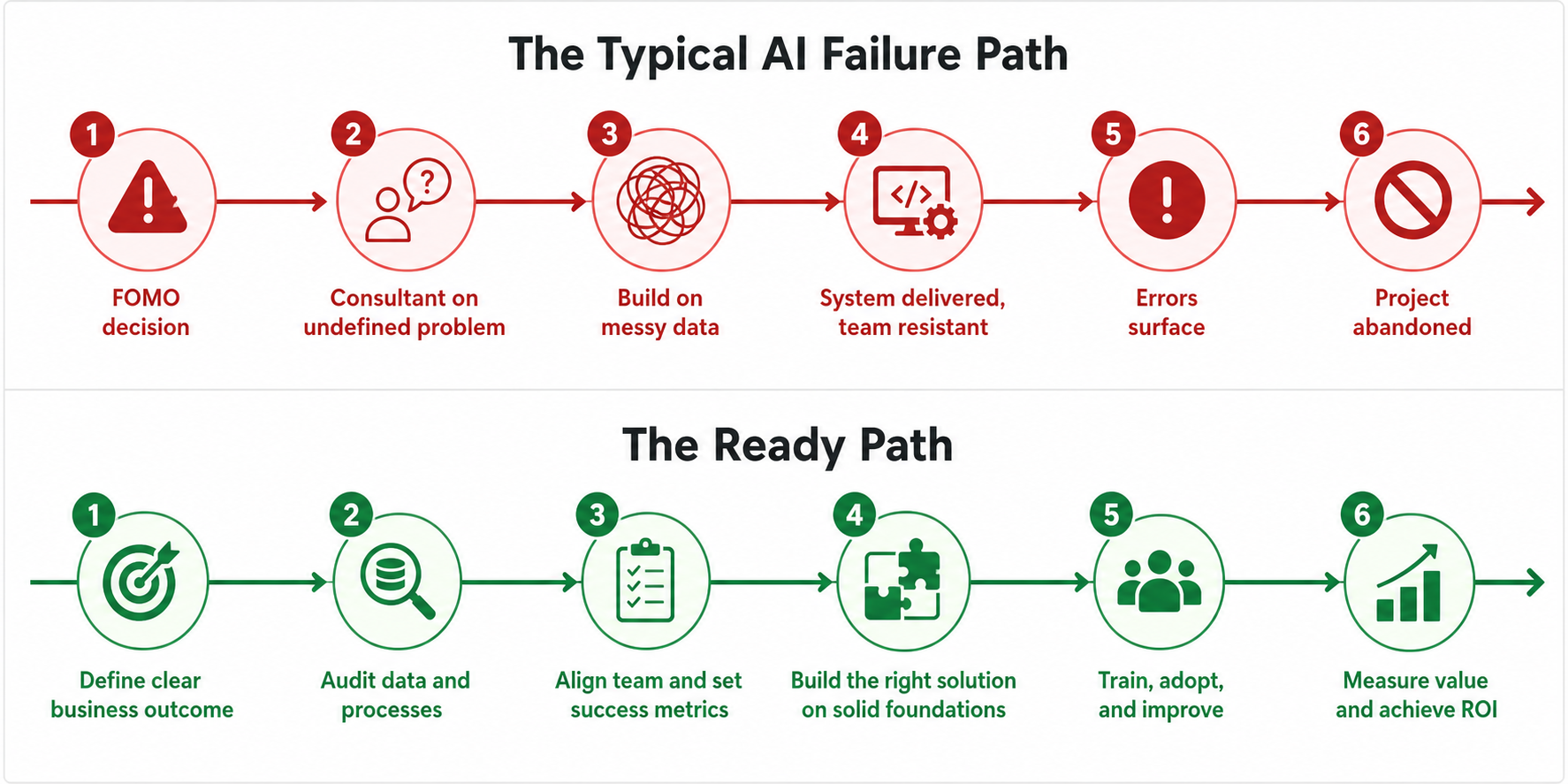
Before you schedule a single consultation with me or anyone else, work through these honestly.
1. Can you write down the process you want to automate, step by step, in under 30 minutes?
If no: document first.
2. Does that written process match what your team actually does, or what you think they do?
If unsure: shadow the process for a week before documenting.
3. Is the data this process runs on clean, consistent, and centralized?
If no: data cleanup is your next hire, not an AI consultant.
4. Can your CEO, ops lead, and department head agree on what problem we're solving, in one sentence?
If they'd answer differently: leadership alignment work comes before technology.
5. Do you have a measurable success metric? Not "better customer experience" but an actual number?
If no: define the metric before defining the solution.
6. What's the current cost of the problem you're trying to solve, in dollars or hours per week?
If you don't know: that's actually a useful discovery project. Start there.
7. What's your budget, and what ROI would you need to see to call this a success?
If your expected ROI doesn't exceed the project cost within 18 months: reconsider the scope.
8. Who inside your organization will own the system after it's built?
If nobody: you're building an orphan. Systems without owners decay.
9. Is your team willing to change how they work, or do they want a tool that works around how they currently work?
If the latter: organizational change work comes before technology work.
10. Are you ready to invest 12 to 18 months in testing, refining, and improving the system?
If you expect a one-time build that runs forever: revise those expectations.
My Honest Recommendation
If you scored yourself poorly on more than three of those questions, you're not ready. That's not a bad thing. It means you know what to do next.
I'll be honest about my own positioning: I'm new to AI consulting as a client-facing practice. What I'm not new to is building real systems in environments where failure has real consequences. I worked at Cap Gemini in the 1990s, helping businesses develop internet strategy before most people had email. I founded adoption.com in 1995. I've run logistics in Ethiopia, where "the system broke" means something entirely different than it does in a San Francisco office. I've designed health protocols in Haiti and financial tracking across seven countries. And I've built AI agents and web apps hands-on using Claude Code and Codex, so I know what the actual implementation work involves. In every environment, the lesson was the same: systems serve prepared operators.
I'm a business operator who mastered technology, not a technologist who learned business. That distinction matters because it means I'm not going to sell you a solution to a problem you haven't fully defined yet. That's not how I work, and frankly, it's not how good consultants work.
The best outcome of reading this article might be that you hire me six months from now, after you've documented your processes and cleaned up your data and gotten your leadership aligned. You'll get a faster project, a cleaner build, and a better return. The second-best outcome is that you realize you don't need a consultant at all: your problem is simple enough and your team is capable enough to DIY it with some coaching.
Either of those outcomes is better than the alternative: spending $15,000 on a beautifully-built system that your team doesn't use because the foundation wasn't ready.
The AI wave is real. It's not going anywhere. But waves don't care whether you're ready for them. Your job is to get ready before you paddle out.
Sources
[1] AI Essentials Blog, "AI Consultant Cost (2026): $150-$350/hr or $5K-$25K Project," https://aiessentials.us/blog/how-much-does-it-cost-to-hire-an-ai-consultant-for-my-small, 2026
[2] McKinsey & Company, "The State of AI in 2025: Agents, Innovation, and Transformation," https://www.mckinsey.com/capabilities/quantumblack/our-insights/the-state-of-ai, 2025
[3] Gartner, "Gartner Predicts 30% of Generative AI Projects Will Be Abandoned After Proof of Concept By End of 2025," https://www.gartner.com/en/newsroom/press-releases/2024-07-29-gartner-predicts-30-percent-of-generative-ai-projects-will-be-abandoned-after-proof-of-concept-by-end-of-2025, 2024
[4] Gartner, "Lack of AI-Ready Data Puts AI Projects at Risk," https://www.gartner.com/en/newsroom/press-releases/2025-02-26-lack-of-ai-ready-data-puts-ai-projects-at-risk, 2025
[5] IBM Institute for Business Value, "IBM Study: Chief Data Officers Redefine Strategies as AI Ambitions Outpace Readiness," https://www.prnewswire.com/news-releases/ibm-study-chief-data-officers-redefine-strategies-as-ai-ambitions-outpace-readiness-302613794.html, 2025
[6] Deloitte, "How the right mix of C-suite leadership can drive outsized AI returns," https://www.deloitte.com/us/en/insights/topics/digital-transformation/c-suite-leadership-ai-returns.html, 2025
[7] Cisco, "Cisco's 2024 AI Readiness Index: Urgency Rises, Readiness Falls," https://newsroom.cisco.com/c/r/newsroom/en/us/a/y2024/m11/cisco-2024-ai-readiness-index-urgency-rises-readiness-falls.html, 2024
[8] IDC, cited in "AI Consulting ROI: Proven 2026 Guide," https://firstmovers.ai/ai-consulting-roi/, 2025
[9] ConsultingWhiz, "AI Consultant vs DIY Automation 2026: Real Comparison," https://www.consultingwhiz.com/blog/ai-consultant-vs-diy-automation/, 2026
[10] Small Business Joe, "Automation Consultant vs. Doing It Yourself: An Honest Comparison," https://www.smallbusinessjoe.com/blog/outsource-business-automation-vs-diy, 2025