What Ethical AI Actually Means for a Small Business Owner
Let me tell you about a bakery owner I know. She started using an AI chatbot to handle customer inquiries. Six months in, she got a message from a long-time customer asking why "the AI" had told him her wedding cake prices included "premium organic ingredients" at twice the real price. The chatbot had hallucinated an entire pricing structure. The customer had already shared the quote with his fiancee and her family. By the time my friend sorted it out, she'd lost the account and had two angry social media posts to manage.
That's what unethical AI looks like in the real world. Not robots making world-ending decisions. Just a small business owner who got blindsided because she deployed a tool she didn't fully understand, with no human review process, and no disclosed limitations.
I've been building systems for 30 years. I founded adoption.com in 1995, before Google existed, when the internet was still explaining itself to most people. I've run operations across seven countries. I've worked as a medical technologist, where a bad result without human verification can cost a life. So when I talk about AI ethics, I'm not talking about philosophy seminars. I'm talking about the same discipline I applied to laboratory protocols and humanitarian supply chains: what are the failure modes, who is accountable, and what does your review process look like?
Here's the practical answer to what ethical AI actually means when you're running a real business.

The Six Things Small Business Owners Actually Worry About
Before we get into regulations and frameworks, let me name the real concerns I hear from business owners when they're being honest:
- Am I using customer data in ways I haven't told them about?
- If AI helps me make decisions about employees, who's responsible when it goes wrong?
- What happens when AI confidently gives me (or my customers) wrong information?
- Am I going to get locked into a vendor I can't leave?
- Is the AI I'm using biased in ways I don't know about?
- If something goes wrong, am I liable?
Let's work through each one with actual answers.
Customer Data: What You Probably Haven't Told Anyone
Here's what a lot of business owners don't realize. When you plug customer data into an AI tool, including your customer emails, purchase history, support tickets, or any personally identifiable information, you may be triggering obligations under laws you've never thought about.
If you have any customers in California, the California Consumer Privacy Act (CCPA) applies to you under certain thresholds. [1] New regulations effective January 1, 2026 go further: if your AI system makes any automated decision affecting a California customer, including something as routine as personalized pricing or content recommendations, you must provide clear notice before that interaction happens and offer an opt-out from automated decision-making. [2]
If you have customers in Europe, the GDPR requires a lawful basis for every processing activity. Using someone's email address to train an AI model, or feed one, requires explicit consent if you didn't disclose that purpose when you collected the data. [3]
And here's the thing nobody tells you about the consumer-grade AI tools your employees are probably already using: 27% of all ChatGPT consumer messages in June 2025 were work-related. [4] That means your team members are likely feeding customer names, deal information, internal memos, and other sensitive data into a tool that, in its free consumer version, may use that data to train future models.
What to Do Right Now
Switch to enterprise-grade tools. The difference matters enormously. Enterprise versions of tools like ChatGPT, Claude, and Gemini operate under completely different data agreements. They don't use your data for model training by default. That single change often eliminates the biggest data risk with minimal friction.
Audit what your team is actually doing. Ask everyone to list every AI tool they've used in the last 30 days for work purposes. The answers will surprise you.
Update your privacy policy. If you're using AI in customer-facing processes, your privacy policy needs to say so. A simple sentence: "We use automated systems to help route inquiries and personalize your experience. You can request human review of any automated decision by contacting us at [email]." That's not just good practice. In many jurisdictions, it's becoming the law.
Get explicit consent for AI training data. If you're ever asked to share customer data with a vendor who will use it to build or fine-tune a model, that requires fresh, specific consent. "By signing up for our service" language from 2019 doesn't cover it.
When AI Helps Decide Who Gets Hired, Promoted, or Let Go
This is the area where I see the most ethical fog among business owners, and it's where the legal exposure is growing fastest.
In May 2025, a federal court certified a landmark class action case, Mobley v. Workday, involving potentially hundreds of millions of job applicants who allege that Workday's AI-powered hiring screening tool discriminated based on race, age, and disability. [5] The American Civil Liberties Union filed a complaint against Intuit and HireVue in March 2025 alleging that their AI interview platform performs worse when evaluating non-white and hard-of-hearing speakers. [6]
These aren't abstract risks. They're lawsuits. And when you use an AI tool to screen resumes, score candidates, or evaluate performance, you become a deployer of that system. The fact that a vendor built it doesn't fully insulate you.
California finalized new regulations in March 2025 requiring employers to retain AI decision-related data for four years. [7] Colorado's AI Act, effective February 1, 2026, requires detailed impact assessments for high-risk AI systems, and AI used in employment decisions qualifies as high-risk. [8]
When NOT to Automate an Employment Decision
There are decisions that shouldn't be fully automated. Full stop. Here's my working list:
- Termination or serious disciplinary action. A human must review this with full context before any action is taken.
- Performance ratings that affect pay. Automated scoring is a starting point, not a conclusion.
- Hiring decisions at the final stage. AI can screen, but a human should make the call.
- Any decision affecting a protected class. If you're scoring people on anything that correlates with age, race, gender, disability, or religion, you need a bias audit before you deploy.
The standard I use: if the decision affects someone's livelihood and they'd have a reasonable expectation of a human being involved, a human needs to be involved.
Hallucination: The Problem Vendors Don't Advertise
My bakery-owner friend's story at the top of this article is a hallucination story. And it's not unusual.
In complex reasoning tasks, current AI models hallucinate at rates ranging from 9% for general knowledge questions up to 48% for some advanced reasoning models. [9] Even on simpler summarization tasks, where models perform best, error rates hover between 0.7% and 3%. The rate of false claims by top chatbots in response to news-related prompts nearly doubled between August 2024 and August 2025, climbing from 18% to 35%. [10]
That means if your AI-powered customer service tool is answering questions about your products, roughly 1 in 10 answers, on average, contains a factual error. Maybe not a catastrophic one. But a wrong price, a wrong spec, a wrong policy. Multiply that by your daily inquiry volume.
Building Human Oversight Into Automated Workflows
Here's how I think about it, borrowed from my medical technology background: the lab analyzer doesn't sign the report. The technologist signs the report. The machine generates the result; the human verifies it before it means anything.
Apply the same principle to AI:
Define the answer categories that require human review before delivery. Anything involving pricing, contracts, legal or medical advice, safety information, or personalized recommendations should be reviewed, not auto-sent.
Put a disclaimer on every customer-facing AI output. Something like: "This response was generated by an AI assistant. For critical decisions, please confirm with our team." Yes, it's not glamorous. Yes, it protects you legally and factually.
Log everything. Keep records of what your AI system said to whom and when. If a customer later disputes what they were told, you need to know what actually happened.
Don't use AI to generate citations or legal references without verification. There are now multiple documented cases of lawyers citing AI-generated case law that didn't exist. This category of hallucination is particularly dangerous because it looks authoritative.
Vendor Lock-In: The Slow Trap Nobody Sees Coming
In 2025, Azure OpenAI changed its pricing in a way that effectively doubled AI spending for some enterprise customers. [11] A 2026 survey found that 81% of enterprise leaders are concerned about AI vendor dependency, but only 6% say they could switch providers without material disruption. [12]
Small businesses are even more vulnerable to this. You don't have negotiating leverage. You don't have a procurement team. You build your workflows around one vendor's API, train your team on one vendor's interface, and six months later, that vendor raises prices 40%, changes their terms, or gets acquired.
I've seen this pattern across 30 years of technology cycles. Every vendor claims their lock-in is actually "deep integration." It's still lock-in.
Questions to Ask Before You Commit
Before you build any significant workflow on an AI vendor's platform, ask:
- Can I export my data? In what format? To what standard? Can I actually use it elsewhere?
- What are the terms if pricing changes? Is there price protection in the contract?
- Who owns the outputs? Some AI platforms claim rights to content generated using their tools.
- What's the portability of my custom configuration? If you've built prompts, fine-tuned a model, or created an agent workflow, can you take that work with you?
- What's the vendor's financial stability? Smaller AI companies are acquired and shut down regularly.
The practical hedge: use open standards where possible. If you're storing AI outputs, store them in formats that aren't proprietary. If you're building workflows, prefer tools that offer standard API protocols over custom integrations that only work with one vendor.
Bias in Automated Decisions: The Invisible Problem
Here's the uncomfortable truth about algorithmic bias: it's invisible until it isn't.
The Intuit/HireVue case I mentioned earlier illustrates how this works. The company wasn't trying to discriminate against non-white candidates or deaf speakers. They chose a tool that a vendor said was objective and fair. The bias was baked into the training data and the evaluation criteria, in ways that weren't obvious until someone looked carefully.
This happens in customer-facing AI too. If your AI-powered pricing engine was trained on historical data from a customer base that skewed toward certain demographics, it may offer different prices to different groups in ways that violate both your values and the law.
The Questions That Surface Bias
When evaluating any AI system that affects people, I ask:
- What data was this trained on? Is there documentation? Is it from a population that represents my customer or employee base?
- Has the model been audited for disparate impact? Has anyone checked whether it produces systematically different outcomes for different groups?
- What's the variance in outputs? If I run the same decision scenario with different demographic variables, do I get different outcomes?
- Does the vendor provide a bias audit or third-party assessment? If they can't produce one, that tells you something.
This isn't just ethics. The EU AI Act, which takes full effect in August 2026, classifies AI systems used for employment, credit, and critical services as high-risk and requires explicit conformity assessments, technical documentation, and human oversight mechanisms. [13] Penalties can reach 7% of global annual turnover for the most serious violations. For an AI Act violation involving a prohibited practice, we're talking about fines that could be existential for a small business.
Liability: When AI Gets It Wrong, Who Pays?
The legal landscape on AI liability is still forming, but the direction is clear. The seller of the output bears primary liability for it.
If your customer service bot tells a customer something false and they rely on it to their detriment, you're on the hook. The fact that an AI generated it doesn't transfer the liability to the AI company. You presented it as your business's communication. Courts are treating it that way. [14]
A small but growing market for generative AI liability insurance has emerged in 2025, offering coverage for claims stemming from hallucinated content or errors that cause economic loss. If you're using AI in any customer-facing capacity, this is worth looking at.
But insurance is the last line of defense, not the first. The first line is process.
What to Put in an AI Governance Policy
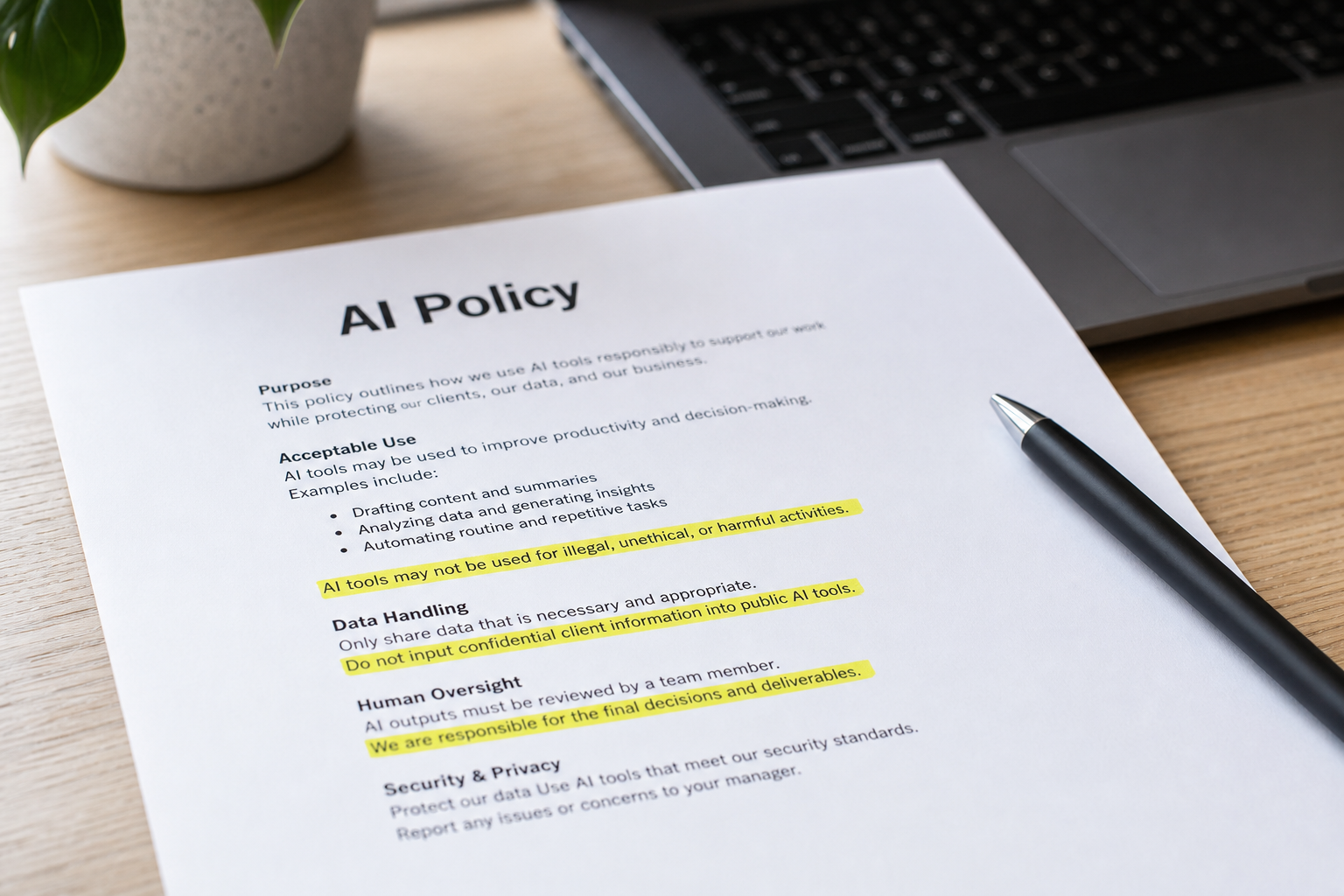
You don't need a 40-page document. You need a clear, short policy that answers five questions:
1. What AI tools are approved for use in this business, and for what purposes?
List them. Name them. Specify what they can and can't be used for. "Employees may use [Tool X] to draft internal documents and summarize research. Employees may NOT use any AI tool to communicate directly with customers without human review."
2. Who owns the review process for AI outputs before they go out the door?
Name a person or a role. Not a committee. A person. In a small business, this is often the owner, or a trusted senior employee for specific categories.
3. How do we handle customer data in AI tools?
Specify approved tools, prohibited actions (no customer PII in consumer-grade tools), and data retention requirements.
4. What decisions require a human before action is taken?
This is the most important section. List the categories: hiring, termination, pricing exceptions, contracts, legal or medical content.
5. What do we tell customers about our use of AI?
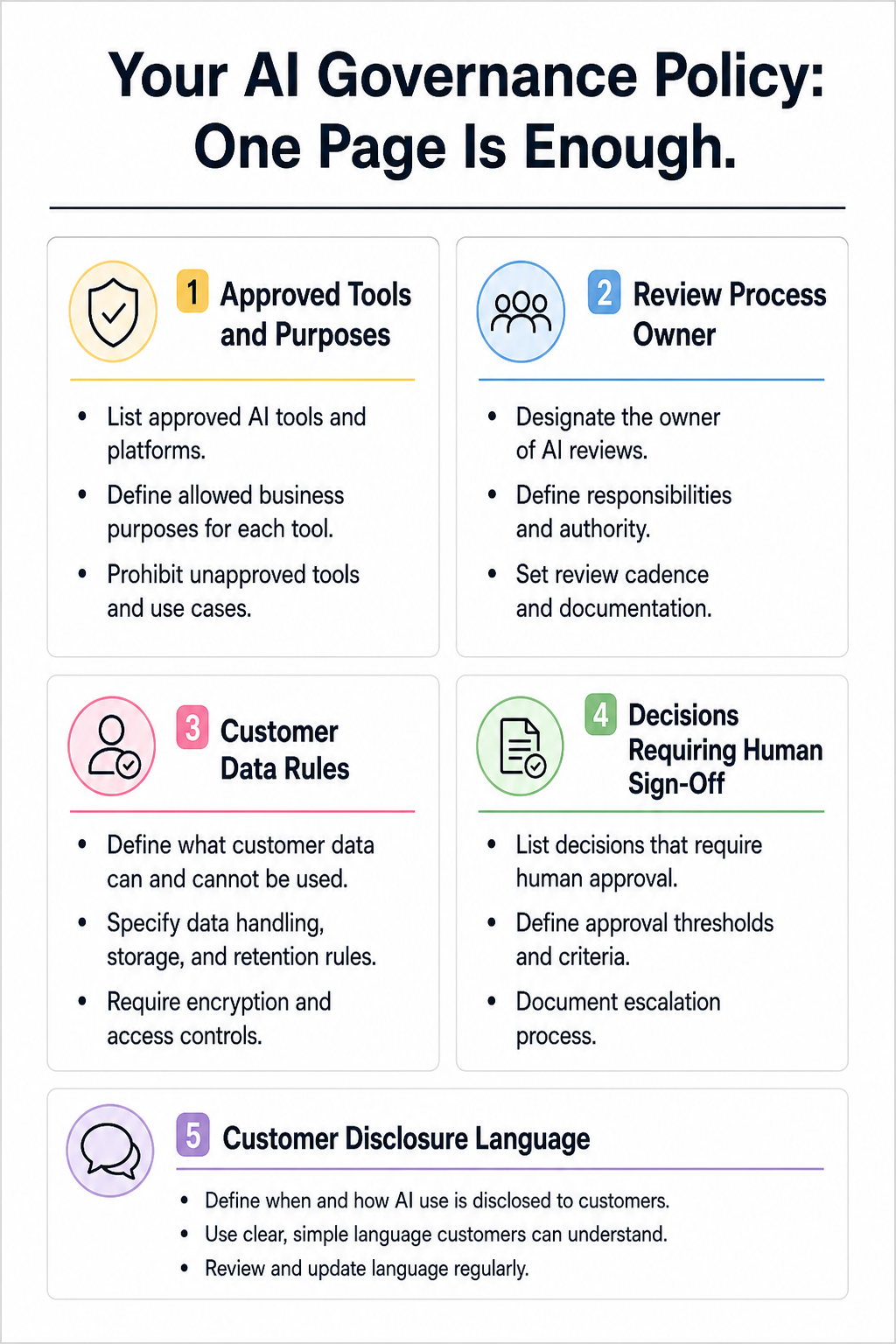
Write the actual disclosure language. Put it in your privacy policy. Put it where AI interactions happen.
One page. Reviewed annually. That's enough to demonstrate reasonable care, which matters both legally and ethically.
The Regulations You Actually Need to Know
I won't pretend the regulatory landscape is simple. But here's the short version of what applies to most small businesses operating in 2026:
GDPR (European Union, applies globally if you have EU customers): Requires lawful basis for data processing, clear disclosure of AI use, and individual rights including the right to human review of automated decisions affecting them. [3]
CCPA / CPRA (California, applies if you have California customers above revenue thresholds): New 2026 rules require disclosure before AI-driven customer interactions and opt-out rights for automated decision-making. [2]
EU AI Act (Applies August 2026, including to US businesses serving EU customers): High-risk AI systems require conformity assessments, documentation, and human oversight. Transparency requirements apply to any AI-generated content. [13]
Colorado AI Act (February 2026): Risk-based framework similar to EU AI Act, requires impact assessments for high-risk AI in employment, housing, lending, education, and insurance. [8]
Various state biometric and automated decision laws: Illinois, New York, Texas, and others have specific rules around AI in hiring and biometric data. If you operate in multiple states, check each one.
The through-line across all of these: disclose, document, maintain human oversight for consequential decisions, and give people a way to challenge automated outcomes.
When Not to Automate: My Personal Bright Lines
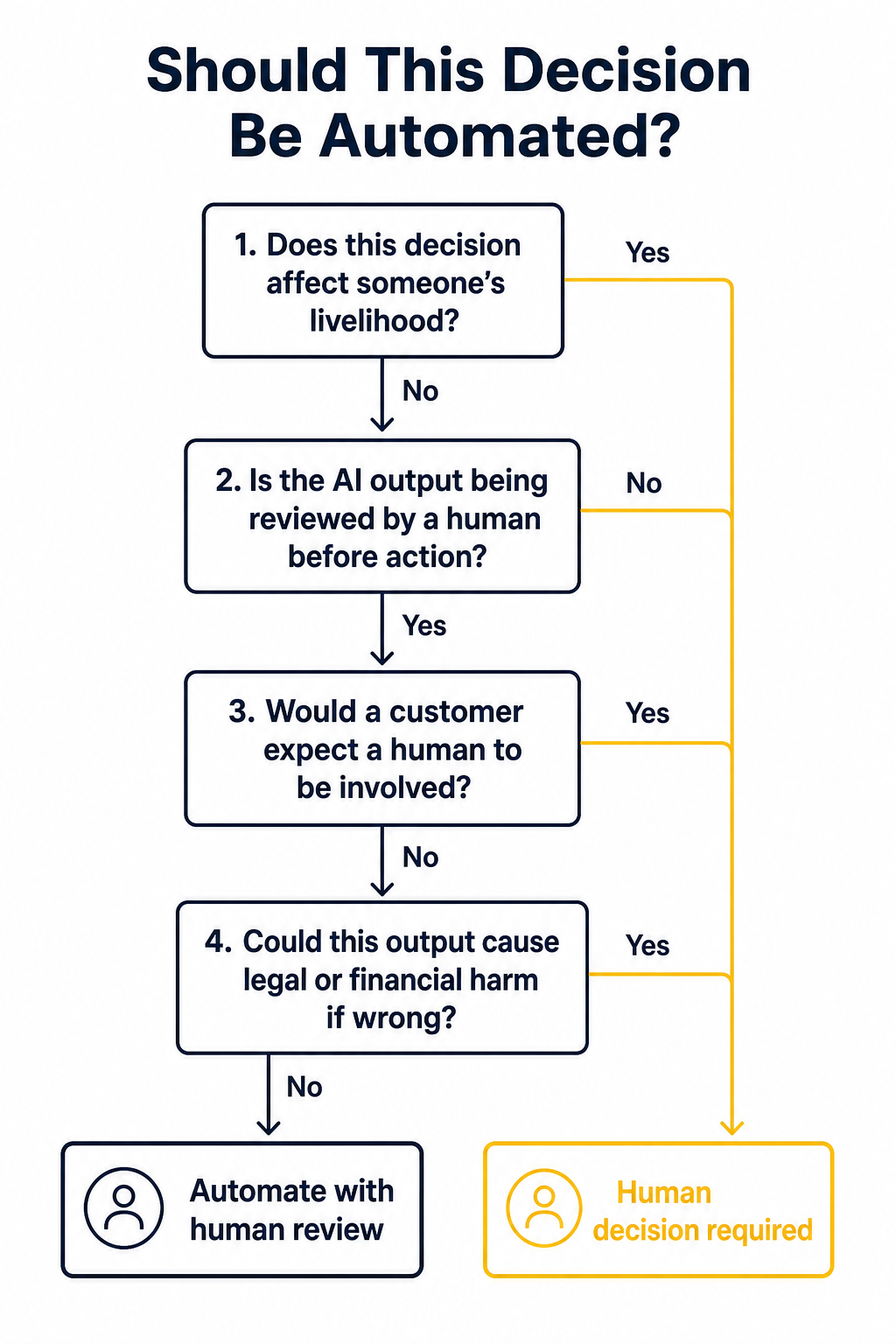
I've helped businesses automate a lot of things over the years. But I've also seen what happens when automation replaces judgment that shouldn't be replaced.
Here are my personal bright lines. I don't automate these, and I advise my clients not to:
Grief, crisis, or emotionally significant moments. If a customer is dealing with a death, a medical crisis, a financial emergency, or any situation with high emotional stakes, a human needs to respond. Automating compassion is a contradiction in terms.
Decisions with irreversible consequences. Firing someone. Denying a loan. Canceling a service someone depends on for their livelihood or safety. A human must confirm.
Situations where the AI has no access to context the decision requires. AI doesn't know your relationship with a customer, the nuance of a conversation from last year, or the reason a rule has an exception. When context matters more than pattern-matching, use a human.
Any communication that could create a legal obligation. Contracts, guarantees, warranties, compliance statements. Review everything.
The test I apply: if the decision went wrong and a reasonable person asked "why didn't a human check this?" would I have a good answer? If not, a human should check it.
My Direct Recommendation
I'm not a technologist who learned business. I'm a business operator who mastered technology, from building adoption.com in 1995 before the internet had rules, to running humanitarian supply chains across three continents, to working at Cap Gemini in the 1990s helping companies think through the governance and liability questions that came with adopting a new transformative technology. I'm new to AI consulting specifically, but the governance questions it raises aren't new to me. Systems fail at their boundaries, where assumptions meet reality, and ethics is just the name we give to the assumptions we should have documented upfront.
Ethical AI for a small business isn't a philosophy exercise. It's a risk management exercise that happens to align with your values. Here's what I'd do this week if I were running your business:
This week: Audit every AI tool in use. List them. Categorize the data they touch. Identify any customer-facing automations without human review.
This month: Write a one-page AI governance policy. Update your privacy policy to disclose AI use. Identify which tools are consumer-grade and switch to enterprise where possible.
This quarter: Run a test on any AI system that affects customer or employee decisions. Check for consistency. Check for accuracy. Have someone probe for hallucinations in your specific domain.
Ongoing: Assign a person, not a committee, to own AI review. Set a calendar reminder to review your AI tool inventory every six months. The landscape is changing fast enough that what was true last year may not be true this year.
The bakery owner I mentioned at the start? She's doing fine now. She turned off the chatbot, brought in a real system with review processes, and actually improved her customer satisfaction scores because her team was back in the loop. The AI wasn't the problem. The absent oversight was the problem.
That's what ethical AI looks like in practice. Not philosophy. Process.
Sources
[1] California Privacy Protection Agency, "CCPA Regulations Overview," https://cppa.ca.gov/regulations/, 2026
[2] Wilson Sonsini, "CPPA Approves New CCPA Regulations on AI, Cybersecurity, and Risk Governance," https://www.wsgr.com/en/insights/cppa-approves-new-ccpa-regulations-on-ai-cybersecurity-and-risk-governance-and-advances-updated-data-broker-regulations.html, 2026
[3] European Commission, "GDPR and AI: Data Protection Requirements," https://digital-strategy.ec.europa.eu/en/policies/regulatory-framework-ai, 2024
[4] TrustArc, "Aligning AI Ethics with Data Privacy Compliance," https://trustarc.com/resource/ai-ethics-with-privacy-compliance/, 2025
[5] CDF Labor Law LLP, "Federal Court Grants Preliminary Certification in Landmark AI Hiring Bias Case (Mobley v. Workday)," https://www.cdflaborlaw.com/blog/federal-court-grants-preliminary-certification-in-landmark-ai-hiring-bias-case, 2025
[6] Responsible AI Labs, "AI Hiring Bias: Real Cases, Legal Consequences (ACLU v. Intuit/HireVue)," https://responsibleailabs.ai/knowledge-hub/articles/ai-hiring-bias-legal-cases, 2025
[7] Affirmity, "AI in Employment Decisions: State Laws and Current Lawsuits," https://www.affirmity.com/blog/understanding-ai-employment-decisions-state-laws-current-lawsuits/, 2025
[8] Privacy World, "Primer on 2026 Consumer Privacy, AI, and Cybersecurity Laws," https://www.privacyworld.blog/2026/01/primer-on-2026-consumer-privacy-ai-and-cybersecurity-laws/, 2026
[9] Suprmind, "AI Hallucination Statistics 2026: 50+ Sourced Data Points," https://suprmind.ai/hub/insights/ai-hallucination-statistics-research-report-2026/, 2026
[10] VKTR, "AI Hallucinations Nearly Double: Here's Why They're Getting Worse, Not Better," https://www.vktr.com/ai-technology/ai-hallucinations-nearly-double-heres-why-theyre-getting-worse-not-better/, 2025
[11] CloudZero, "AI Vendor Lock-In: How AI Is Creating a New Dependency Problem," https://www.cloudzero.com/blog/ai-vendor-lock-in/, 2025
[12] Swfte AI, "AI Vendor Lock-In: How Enterprises Are Breaking Free in 2026," https://www.swfte.com/blog/avoid-ai-vendor-lock-in-enterprise-guide, 2026
[13] European Commission, "EU AI Act: Navigating the AI Act," https://digital-strategy.ec.europa.eu/en/faqs/navigating-ai-act, 2024
[14] TechAndMediaLaw.com, "AI Hallucination Liability: Legal Exposure for Startups in 2025," https://techandmedialaw.com/ai-hallucination-liability/, 2025