Why Your Employees Fear AI (And How to Lead Them Through the Transition)
Picture this. A CEO announces an AI rollout at the all-hands meeting. The slide deck is polished. The ROI projections are compelling. HR has already signed the vendor contract. And within 48 hours, the Slack channels are quietly buzzing with a different conversation, the one leadership isn't part of.
Is my job next? Do I have to pretend I know how to use this thing? What happens if I ask a dumb question?
I've built systems on four continents and have been running technology operations since before Google existed. I founded adoption.com in 1995, when the internet was so new that most people still called it "the information superhighway." I've led teams through seismic technology transitions more times than I can count, in countries where the stakes were literal life and death, not just quarterly earnings. And I'm telling you: the CEO's AI announcement is almost never the problem. The silence that follows it almost always is.
The number one reason AI implementations fail isn't technical. It's human. And until leaders address the three specific fears driving that silence, the most sophisticated AI stack in the world won't move the needle.

The Fear Nobody Is Measuring Correctly

Here's a statistic that should stop every executive in their tracks. According to a 2025 Pew Research Center study of over 5,000 employed U.S. adults, 52% of workers say they're worried about the future impact of AI in the workplace, while only 36% say they feel hopeful.[1] That's not close. That's a 16-point gap between fear and hope, in a country that invented Silicon Valley.
But the Mercer Global Talent Trends 2026 report, which surveyed nearly 12,000 executives, HR leaders, and employees worldwide, finds something even more revealing: 62% of employees agree that leaders underestimate AI's emotional impact, yet only 19% of HR leaders factor those emotional impacts into their digital implementation strategy.[2] Let me translate that. Most employees think their leaders don't get it. Most HR leaders confirm that they genuinely don't, because they're not even trying to measure it.
This isn't a communications problem. It's a leadership problem wearing a communications costume.
The Three Fears That Actually Drive Resistance
Over the past few years, I've watched companies pour millions into AI tools that teams quietly abandon, workaround, or perform compliance with while never actually changing how they work. When you trace the resistance back to its source, it almost always comes down to one of three fears:
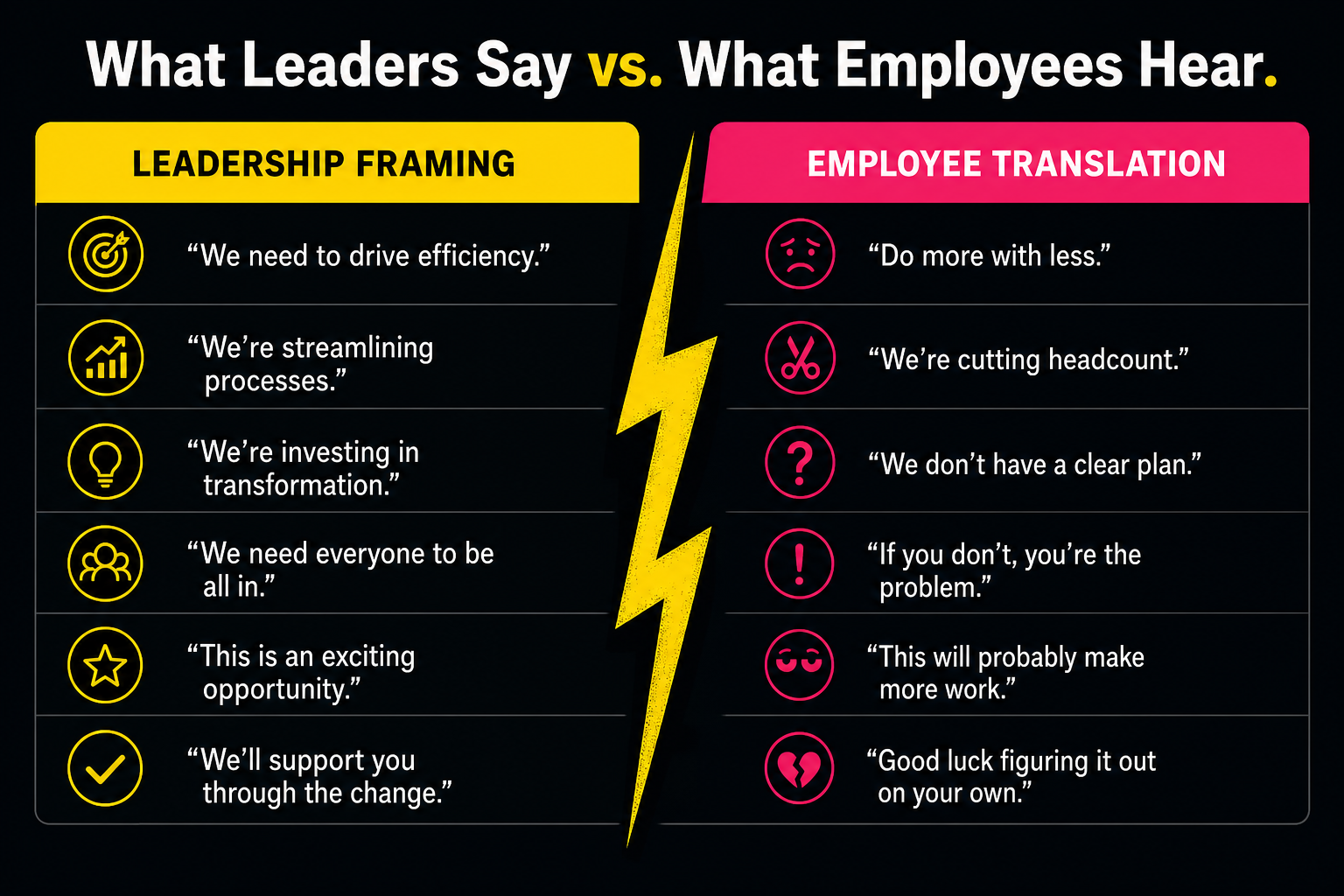
Fear 1: Job replacement. This one's the most obvious and the most discussed, which is why it's also the most mismanaged. The fear isn't abstract anymore. Companies attributed 55,000 job cuts directly to AI in 2025, a 12x increase from 2023, with tech roles absorbing the majority of those losses.[3] And 43% of workers now personally know someone who lost a job due to AI.[3] When your employee hears "we're implementing AI for efficiency," their nervous system hears "we're building your replacement." They're not wrong to make that connection. You're asking them to trust you while the news is full of counterexamples.
Fear 2: Looking incompetent. This one is far less discussed and far more corrosive. Nobody wants to be the person in the meeting who asks the dumb question about the AI tool everyone else seems to understand. And because AI tools are evolving so fast, most employees are learning on their own, outside of work. The EY Agentic AI Workplace Survey from October 2025, which polled over 1,100 desk workers at companies with $1 billion or more in revenue, found that 85% of workers are learning about AI agents outside of work, and 83% say most of what they know is self-taught.[4] That's not enthusiasm. That's people trying desperately to not get left behind while their employer isn't helping.
Fear 3: Being left behind permanently. This is the slow-burn version. Workers aren't just afraid of losing their current job. They're afraid that if they don't get the skills now, they'll be unemployable in five years. According to Mercer, employee concern about AI-related job loss surged from 28% in 2024 to 40% in 2026, the sharpest two-year jump in the survey's history.[2] The EY survey adds to this: 56% of workers worry that agentic AI will make their jobs obsolete, even while 84% say they're simultaneously eager to embrace it.[4] That paradox is not confusion. It's a completely rational response to a situation where the upside and the threat are both real.
What Leaders Get Wrong
I'm a medical technologist by background. I spent years in clinical settings where precision matters, where you don't get to say "good enough" or "close counts." That training has followed me through 30 years of building real systems across seven countries, and it's what I bring to AI consulting today. And with that lens, I can tell you exactly what I see leaders doing wrong.
The Efficiency Announcement Trap
The most common mistake is announcing AI as an efficiency play without naming the fear. "We're implementing AI to increase productivity and stay competitive." Reasonable sentence. Fatal framing.
The moment employees hear "efficiency," they do the math. If AI makes me 30% more productive, why does the company need my full role? This isn't paranoia. Forty percent of employers globally say they expect to reduce their workforce where AI can automate tasks.[5] When leaders don't address this reality directly, employees fill the silence with the worst possible interpretation. And they're often right to.
Clear communication about AI actually drives outcomes. The EY survey found that at organizations that clearly communicate their AI strategy, 92% of workers report AI has positively impacted their team's productivity, a 30-point jump compared to organizations without clear communication.[4] The tool didn't change. The conversation around it did.
The Top-Down Deployment Problem
Most AI rollouts follow a familiar pattern. Leadership decides, IT implements, training department runs a two-hour session, and everyone is expected to be on board by Q2. This process fails not because people are resistant to change. It fails because nobody asked them anything.
McKinsey's research on AI adoption reveals a troubling perception gap: C-suite leaders are more than twice as likely to say employee readiness is the barrier compared to blaming their own leadership failures, but the employees themselves say they're actually quite ready.[6] Leaders think the problem is their people. The people think the problem is their leaders. They're both partially right and talking past each other.
The Training Desert
Here's the number that keeps me up at night. Seventy-seven percent of employers say they plan to reskill workers for AI over the next five years. Only 13% of employees have received any AI training so far.[5] That gap isn't a rounding error. It's a broken promise.
If you tell your team AI is the future and then don't invest in teaching them how to operate in that future, you're not just leaving opportunity on the table. You're actively creating the fear you're trying to overcome. You're saying "this is important" with your words and "not important enough to actually help you with" with your actions.
What Actually Works
I want to be direct here, because there's a lot of fluffy change management advice that sounds good in a workshop and dissolves the moment it meets a real organization. What I'm sharing is grounded in both research and the kind of hard-won operational experience you only get from building systems that have to survive contact with reality.
Step One: Name the Fear Out Loud
The most powerful thing a leader can do in an AI transition is say the thing everyone is thinking but nobody is saying. In a staff meeting, in a memo, in a town hall, it doesn't matter. What matters is that you say it plainly.
"I know some of you are worried about your jobs. Let's talk about that directly."
That sentence does more work than any polished deck about AI's potential. Why? Because the Cornell University research on AI monitoring found that the framing of AI makes all the difference in how workers respond. When workers were told an AI tool would monitor their work and provide developmental feedback, they didn't report loss of autonomy or greater intention to quit. When the framing was surveillance and judgment, the opposite happened: workers complained more, generated fewer ideas, and performed worse.[7] The tool was identical. The communication changed everything.
You don't have to have all the answers when you name the fear. You just have to acknowledge it's real. That alone shifts people from defense mode to problem-solving mode.
Step Two: Involve Staff in the Design
One of the most reliable predictors of AI adoption success is whether employees had any say in how it gets implemented. Gartner's 2026 change management research for CHROs identifies employee involvement as a critical lever, specifically for major strategic shifts or changes that would likely fail without it.[8]
I've seen this work in practice. When you bring a cross-functional group of employees into the design process, even just a small pilot team, three things happen. First, they catch practical problems that no vendor demo would ever surface. Second, they become your internal champions, because people advocate for what they helped build. Third, they signal to the rest of the organization that this isn't something being done to them. It's something being built with them.
This doesn't mean you need employee approval for every decision. It means you involve the people who will live with the system in designing how it works.
Step Three: Find Your Early Adopters First
Every organization has them. The person who already figured out how to use AI on their own. The curious one who's been experimenting with tools on evenings and weekends. The one who sends everyone links to "you have to try this."
These people are your change engine. Find them before you launch anything formally. Give them early access. Give them a 30-to-60-day runway to experiment and build confidence. Then make them visible.
Research on high-performing AI organizations consistently shows that organizations sustaining 80% or more active AI usage have built internal AI learning communities, not just one-time training events.[9] The early adopter becomes the peer teacher. The peer teacher is trusted in a way that no vendor training and no management mandate ever will be. People learn a new way of working from someone they trust, not from a company announcement.
Step Four: Protect Learning Time
This is where most leaders cut corners and pay for it later. The EY survey found that 59% of employees cite lack of adequate training as an organizational barrier to AI adoption, even among workers at large, well-resourced companies.[4] But the problem isn't just that training doesn't exist. It's that when training exists, it gets scheduled on top of an already full workday with no reduction in other obligations.
You can't ask people to learn a new operating system for their entire job while running at 100% capacity on the old one. Something has to give. The best-performing AI transitions I've seen carve out protected time, actual calendar blocks where experimentation is the job, not something squeezed in around the real work.
Microsoft's Work Trend Index research is stark on this point: 80% of the global workforce reports lacking the time or energy to meet increased productivity demands.[10] If you're rolling out AI specifically to increase productivity, and your people are already running on empty, you've created a perfect conditions for a failed adoption. You have to give capacity before you can demand output.
Step Five: Celebrate the First Wins Publicly and Specifically
Vague praise doesn't move culture. "Great job everyone embracing AI" lands like a participation trophy. What moves culture is specificity.
"Maria on the contracts team figured out how to use the AI summary tool to cut her first-pass review time from four hours to 45 minutes. She used that time to close two additional deals last month. Here's what she did."
That kind of story does several things at once. It makes the benefit concrete and real, not theoretical. It makes a real person the hero, not the technology. And it answers the question every resistant employee is silently asking: "What does this actually look like for someone like me?"
Step Six: Retrain. Don't Just Replace.
The headline layoff numbers are real and I'm not going to sugarcoat them. But the narrative that AI simply replaces human workers is too simple and ultimately self-defeating for most organizations.
The World Economic Forum has projected that while AI will displace some roles, the net effect over the next few years will be a significant number of new job categories that don't exist today. But those new jobs require different skills, and you have to start building those skills before the old jobs disappear, not after.
The organizations that will come out ahead aren't the ones that used AI to cut headcount the fastest. They're the ones that used the productivity gains from AI to redeploy their best people into higher-value work. That requires a retraining commitment, not a layoff strategy.
When your employees believe that's your actual plan, the entire energy of the AI rollout shifts. They go from protecting their turf to figuring out how to evolve into the next version of their role.
A Week-by-Week Change Management Approach
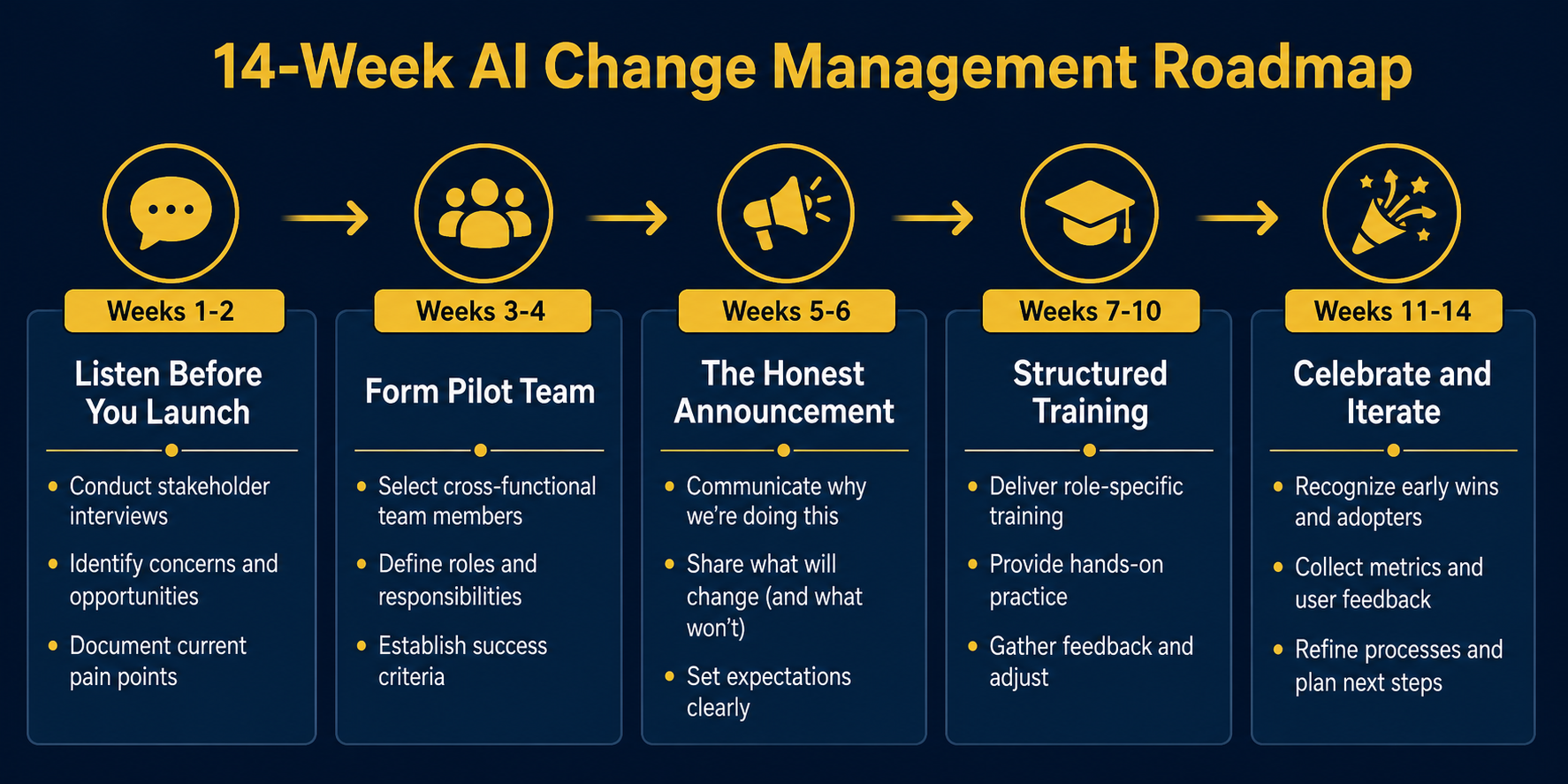
I don't love overly prescriptive frameworks, because every organization is different. But I know leaders want something concrete to hold onto, so here's a rough roadmap that works. Adapt it to your reality.
Weeks 1 to 2: Listen Before You Launch
Before you announce anything, run listening sessions. Small groups, not all-hands. Ask three questions: What concerns do you have about AI in our work? What would make you feel supported through this change? Where do you think AI could actually help you do your job better?
You will learn things in these sessions that will make your entire rollout better. And the fact that you asked before you announced will matter to people more than you expect.
Weeks 3 to 4: Form a Pilot Team
Identify eight to twelve people across departments, including some enthusiasts and some skeptics. Give them early access to whatever you're implementing. Their job isn't to be sold on the tool. Their job is to break it, improve it, and tell you what the rollout actually needs to look like.
Pay attention to who the skeptics are. A converted skeptic is a more powerful advocate than a natural enthusiast, because they speak to the doubts the majority is holding.
Weeks 5 to 6: The Honest Announcement
Now you communicate to the full organization. And you lead with the hard questions, not the glossy benefits. Something like:
"We're rolling out AI across our operations over the next six months. I want to be direct with you about what that means. Some processes will change significantly. Some roles will evolve. We're committed to equipping everyone here with what they need to grow with us through this change. Here's what we know, here's what we don't know yet, and here's how you can be part of shaping how this works."
Notice what that statement does. It acknowledges uncertainty instead of pretending certainty. It connects the change to employee growth, not just company efficiency. And it creates a clear invitation for involvement.
Weeks 7 to 10: Structured Training With Protected Time
Roll out training in waves, department by department, with actual time carved out of the workweek. Not a lunch-and-learn. Not an optional webinar at 5 pm. Dedicated, protected learning time during business hours that signals this is real work, not an add-on.
Pair each training session with a peer practice element. Two people, one tool, a real work problem, 30 minutes. People learn faster when they're solving an actual problem they care about, not a simulated exercise.
Weeks 11 to 14: Celebrate, Iterate, and Surface the Skeptics' Input
Hold a visible recognition moment for the first wins. Specific, named, with the actual impact stated. Then open a feedback channel, not a suggestion box that nobody reads, but a structured monthly debrief where teams report what's working, what isn't, and what they want to try next.
This is where Gartner's research becomes critical: organizations that continuously adapt change plans based on employee responses are four times more likely to achieve change success.[8] The rollout isn't a one-time event. It's a system that gets better over time because you built feedback into the design.
The Honest Truth About What This Requires of Leaders
I've spent 30 years building systems in conditions where the human stakes were real: running humanitarian operations across Ethiopia, Kenya, and Haiti, managing teams through technology transitions that weren't optional, and watching what happens when leaders aren't honest about what they don't know. I'm new to AI consulting specifically, but I've been in the room for this kind of change before. At Cap Gemini in the 1990s, we helped large organizations navigate the internet's arrival, and the employee fear pattern was identical: people were afraid of being made obsolete by something they didn't understand yet, and leadership kept talking about efficiency gains instead of addressing that fear directly.
Your employees don't need you to have all the answers about AI. They need to know you're not hiding the hard questions.
The Mercer data is unambiguous on this: only 44% of employees currently report thriving at work, down from 66% in 2024, a level even lower than during the COVID-19 pandemic, and AI anxiety is a significant contributing factor.[2] That's not a statistic about technology. That's a statistic about trust.
What your employees see in the details of how you handle this transition tells them far more about what AI really means for their future than anything you'll put in a presentation. Are you using the tools you're rolling out? Are you protecting time for learning, or demanding productivity gains before the skills are built? Are the people affected by efficiency cuts given real support? Those details are the message.
The Bottom Line
AI isn't the disruption your employees are afraid of. You are. Or more precisely, the version of leadership that treats AI as a cost-cutting tool and a productivity announcement, without a human change strategy underneath it.
The good news is that the research is clear: fear doesn't have to win. The EY survey found that 84% of employees are eager to embrace AI when they're supported in doing so.[4] Most of your people want to figure this out. They're already trying to figure it out on their own time, at their own expense, with no guidance from you.
Give them the name for what they're afraid of. Give them a seat at the table in designing the change. Give them protected time to learn. Give them a peer who's ahead of them showing what's possible. Give them honest communication about what the change means for their role. And give them concrete evidence that you're in this with them, not doing it to them.
Do that, and the fear doesn't disappear. But it gets replaced by something much more useful: momentum.
I'm Annette Thompson. I'm the founder of Verity Agentic, and I've been building systems that have to work in the real world since before most AI companies existed. If you're navigating an AI transition and want to talk through what your organization actually needs, I'm happy to have that conversation.
Sources
[1] Pew Research Center, "On Future AI Use in Workplace, US Workers More Worried Than Hopeful," https://www.pewresearch.org/social-trends/2025/02/25/u-s-workers-are-more-worried-than-hopeful-about-future-ai-use-in-the-workplace/, 2025
[2] Mercer, "Global Talent Trends 2026 Report," https://www.mercer.com/about/newsroom/mercer-s-global-talent-trends-2026-report/, 2026
[3] Challenger, Gray & Christmas, cited in Metaintro, "40% of Workers Now Fear Losing Their Job to AI," https://www.metaintro.com/blog/40-percent-workers-fear-losing-job-to-ai-2026, 2026
[4] EY, "New EY Survey Reveals Majority of Workers Are Enthusiastic About Agentic AI, But Leadership Gaps in Communication and Lack of Training Threaten Impact," https://www.ey.com/en_us/newsroom/2025/10/new-ey-survey-reveals-majority-of-workers-are-enthusiastic-about-agentic-ai-but-leadership-gaps-in-communication-and-lack-of-training-threaten-impact, 2025
[5] Randstad/Multiple sources cited in The Network Installers, "AI in the Workplace Statistics and Trends in 2026," https://thenetworkinstallers.com/blog/ai-in-the-workplace-statistics/, 2026
[6] McKinsey, "Leaders Underestimate Employees' AI Use," https://www.mckinsey.com/featured-insights/week-in-charts/leaders-underestimate-employees-ai-use, 2025
[7] Cornell University, "More Complaints, Worse Performance When AI Monitors Work," https://news.cornell.edu/stories/2024/07/more-complaints-worse-performance-when-ai-monitors-work, 2024
[8] Gartner, "Gartner Identifies the Top Change Management Trends for CHROs in the Age of AI," https://www.gartner.com/en/newsroom/press-releases/2026-3-16-gartner-identifies-top-change-management-trends-for-chros-in-age-of-ai, 2026
[9] Lead.app, "AI Change Management That Teams Actually Adopt," https://www.lead.app/ai-change-management/, 2026
[10] Microsoft, "Work Trend Index Annual Report 2025," https://www.microsoft.com/en-us/worklab/work-trend-index, 2025