I've Been Building Systems Since 1995. Here's What Everyone Gets Wrong About AI Implementation.
In 1995, I launched adoption.com before most people had heard of the internet. Google wouldn't exist for another three years. There was no playbook, no roadmap, no "best practices" guide I could download. There was just a problem worth solving, a process I had to design from scratch, and technology that would either serve that process or derail it.
What I learned in those early days has held up across 30 years, seven countries, three continents, and now the biggest technology shift most of us will see in our lifetimes.
And here's what I keep watching businesses get wrong with AI: they're making the exact same mistake that killed technology initiatives in 1998, in 2003, in 2011, and in 2018. They're trying to automate chaos instead of systematizing it first.
The tool has changed. The failure mode hasn't.

The Number That Should Stop Everyone Cold
More than 80% of AI projects fail. That's not a fringe opinion or a pessimist's take. That's what RAND Corporation found after interviewing 65 experienced data scientists and engineers in 2024, and it's roughly twice the failure rate of comparable IT projects that don't involve AI.[1]
For generative AI specifically, it's even worse. MIT's Project NANDA published a report in 2025, based on 150 executive interviews, a survey of 350 employees, and analysis of 300 public AI deployments. Their finding: only about 5% of AI pilot programs achieve rapid revenue acceleration. The other 95% stall, delivering no measurable impact on profit and loss.[2]
In 2025, enterprises poured $684 billion into AI. By year-end, more than $547 billion of that investment had produced no measurable results.[3]
Let that sink in for a moment.
This isn't a technology problem. It's a systems problem. And it's one I've seen play out in every technology wave since I was coding on dial-up in the mid-nineties.
What 30 Years of Building Taught Me
I'm not a technologist who learned business. I'm a business operator who mastered technology. That distinction matters more than most people realize.
When I built adoption.com in 1995, I had to understand the process before I could build anything. Who was looking for children to adopt? What information did they need? In what sequence? What happened when a match was made? Who needed to be notified, when, and how? The technology was just the delivery vehicle. The process was everything.
That same discipline carried over when I was running orphanages in Ethiopia, Kenya, and Haiti. When you're managing humanitarian operations across three continents with minimal budget and unreliable infrastructure, you learn very quickly what happens when the system breaks down. There's no margin for "we'll figure it out as we go." The stakes are too high and the resources too thin.
My background as a medical technologist reinforced this even further. In a clinical laboratory, precision isn't optional. You don't wing it. Every step in a diagnostic process is documented, validated, and audited. The data has to be clean before the result can be trusted. You don't build the analysis on top of questionable inputs and hope for the best.
I carry all of that with me into every AI engagement I take on today.
The Five Real Reasons AI Fails
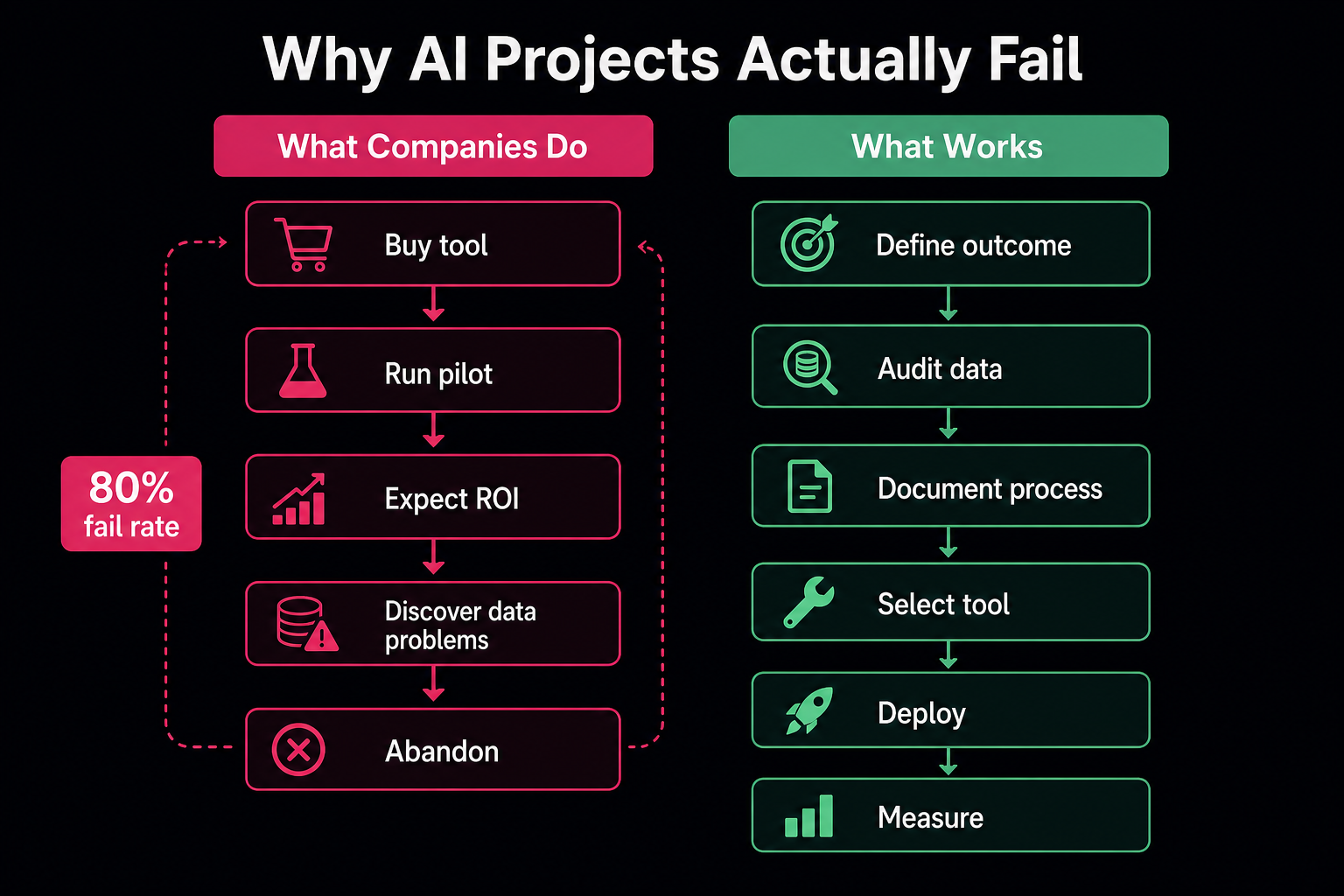
RAND's research pinpointed five root causes of AI implementation failure.[1] Read them carefully, because only one is primarily technical:
- Misunderstood problem definition. Stakeholders miscommunicate what problem AI actually needs to solve.
- Inadequate training data. Organizations lack data of sufficient quality and accessibility.
- Technology-first mentality. Organizations select tools based on hype rather than problem fit.
- Insufficient infrastructure. Systems can't deploy completed models into production.
- Problem too difficult. AI is applied to problems beyond current technical capabilities.
Four out of five causes are organizational, strategic, or procedural. Not technical. And successful implementations reflect this: they allocate roughly 70% of resources to people and processes, not algorithms or technology.[1]
But here's what I find most telling. Seventy-three percent of failed AI projects had no agreed definition of success before the project started.[3] And 61% of enterprise AI projects were approved on projected ROI that was never measured after launch.[3]
You can't steer toward a destination you haven't defined. You can't learn from results you don't measure. These aren't AI problems. They're management problems wearing an AI costume.
The Data Problem Is Even Worse Than You Think
If I had to pick the single most underestimated problem in AI implementation today, it's data readiness.
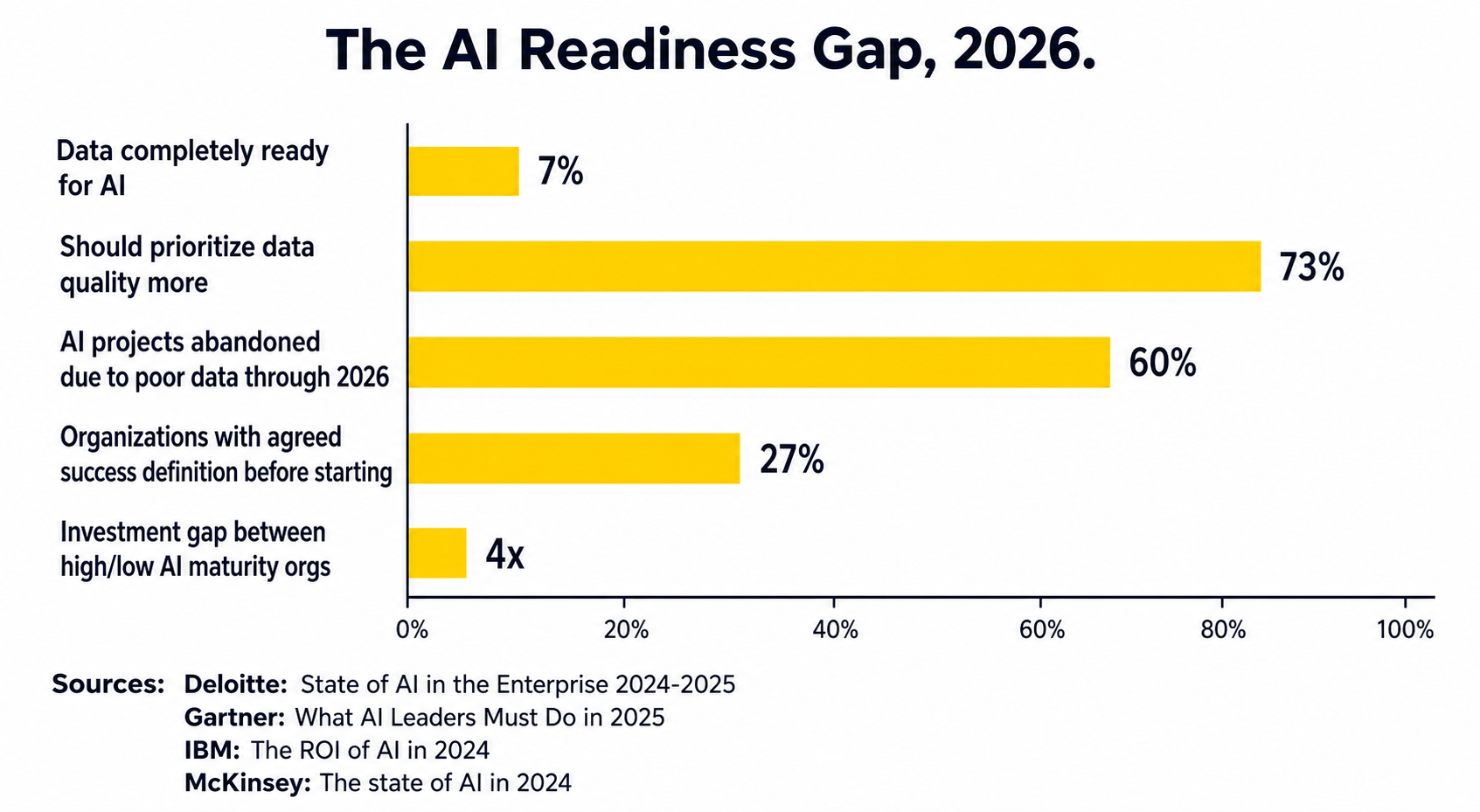
In March 2026, Cloudera and Harvard Business Review Analytic Services surveyed more than 230 business leaders. Only 7% said their organization's data is completely ready for AI adoption. More than a quarter said their data is "not very" or "not at all" ready.[4]
Seven percent. That means 93% of organizations are trying to build AI systems on a foundation that isn't ready.
Gartner's research backs this up with a stark prediction: through 2026, organizations will abandon 60% of AI projects unsupported by AI-ready data.[5] Not because the AI failed. Because the data wasn't there to support it.
And yet, organizations with successful AI initiatives invest up to four times more in data and analytics foundations than those that see poor outcomes, according to Gartner's April 2026 research covering 353 data and analytics leaders.[6] Those high-maturity organizations are achieving up to 65% greater business outcomes, including revenue growth and cost optimization.[6]
The pattern is obvious: clean the data, build the foundation, get results. Skip that step, waste the money.
I spent years running medical lab operations where this principle was just called "good science." You don't run the assay on a compromised sample. You go back and get a clean one. The same logic applies here and somehow, in the excitement over AI, people keep forgetting it.
The S&P Global Wake-Up Call
Here's a trend line that should concern anyone who's watching the AI space closely.
S&P Global Market Intelligence surveyed 1,006 midlevel and senior IT and line-of-business professionals across North America and Europe in 2025.[7] They found that the percentage of companies abandoning the majority of their AI initiatives before reaching production had surged from 17% to 42% in a single year. On average, organizations reported scrapping 46% of AI proof-of-concepts before broad adoption.
That's not a plateau. That's acceleration in the wrong direction.
The reason companies are abandoning more AI projects isn't that AI has gotten harder. It's that they rushed the foundation, hit the wall of data and process problems they should have anticipated, and couldn't recover. The S&P survey identified cost, data privacy, and security risks as the top obstacles.[7]
Those three things are all manageable with proper systems design up front. They become unmanageable when you discover them mid-deployment.
I've seen this pattern before. In the late nineties, companies rushed to build websites without understanding what those websites were actually supposed to do for their customers. In the early 2000s, they rushed into ERP systems without cleaning their data first. In the 2010s, they deployed CRMs on top of messy contact databases and wondered why adoption was low.
Same movie. Different title.
What the Successful 5% Actually Do

So what separates the 5% who get it right from the 95% who don't?
MIT's research offers a clear answer. The main cause of failure is not technological but organizational. They call it the "learning gap": the inability to integrate AI models into workflows, structures, and cultures.[2]
Companies that purchase AI tools from specialized vendors and build partnerships succeed about 67% of the time. Internal builds succeed only one-third as often.[2] The difference isn't the technology. It's the implementation infrastructure and the organizational discipline to actually change how work gets done.
Gartner's research on high-maturity AI organizations tells a similar story.[8] Organizations with the highest maturity of AI-ready capabilities achieve dramatically better outcomes, and 91% of leaders in those organizations have appointed dedicated AI leaders. Not outsourced it to a committee. Not made it someone's side project. Made it someone's actual job.
McKinsey's 2025 State of AI report found that AI high performers are more likely to redesign workflows around AI rather than just layering AI on top of existing processes.[9] They're thinking about how work should change, not just how to automate what already exists.
This is the distinction I keep coming back to. AI isn't a layer you add. It's a reason to rethink the underlying process.
The Lesson from Humanitarian Operations
When I was running operations across Ethiopia, Kenya, and Haiti, I learned something about resource-constrained environments that applies directly to AI: the less margin you have for error, the more discipline you need in your systems design.
We couldn't afford to improvise. We had to know exactly what would happen at every decision point, who was responsible for what, and what the data trail looked like. Not because we were bureaucratic, but because the consequences of chaos were real and immediate.
What I observe in most AI implementations is organizations with significant resources behaving as though they have none of the discipline. They move fast, skip the process documentation, skip the data audit, and then wonder why the AI is producing unreliable outputs or creating more problems than it solves.
You can't automate chaos. I learned that in 1995 and it's still true today.
The "Tool First" Trap
MIT's research named this directly: the most common single reason AI projects fail is that companies treat AI as a technology purchase instead of a business strategy problem.[2]
I see this constantly. A leadership team reads about a competitor using AI. They schedule a vendor demo. They sign a contract. They announce internally that they're "doing AI now." And then, six months later, nothing has changed because no one went back and answered the foundational questions: What problem are we actually solving? For whom? What does success look like and how will we measure it? What does the data currently look like and what would it need to look like? Who owns the process change?
Technology doesn't solve messy thinking. It amplifies it.
In a clinical lab, we had a saying: garbage in, garbage out. A beautiful, expensive instrument produces a beautiful, expensive wrong result if the sample is compromised. AI is the same. You can have the most capable model available, and if the data feeding it is inconsistent, incomplete, or ungoverned, the output will reflect that.
Seventy-three percent of respondents in the Harvard Business Review and Cloudera study said their organization should be prioritizing AI data quality more than it currently is.[4] And yet most of those same organizations are spending their budgets on AI tools, not on the data infrastructure that would make those tools work.
The Three Things That Have to Come First
In 30 years of building systems that have to survive contact with reality, across wildly different contexts from a 1990s internet startup to orphanages in sub-Saharan Africa to clinical laboratories, I've arrived at a short list of things that have to be true before any technology works. AI is no exception.
First: you have to know what you're actually trying to accomplish. Not in the abstract. Not "we want to be more efficient." Specifically. What output, for whom, by when, measured how? This sounds obvious but 73% of failed AI projects skipped this step.[3]
Second: your data has to be ready. Not perfect. Ready. Cleaned, governed, structured around the specific use case you're building for. Only 7% of enterprises say their data is completely ready for AI.[4] That number has to improve before any tool you buy can deliver what it promises.
Third: the process has to be documented before you automate it. You can't automate what you can't describe. If the process isn't documented, AI will automate whatever people happen to be doing, which may bear no resemblance to what they should be doing. That's not a step forward. It's a very expensive step sideways.
These three things aren't glamorous. They don't make for exciting vendor demos or compelling press releases. But they're the difference between the 5% that succeed and the 95% that don't.
What Verity Agentic Does Differently
When I founded Verity Agentic, I made a deliberate choice about what kind of firm it would be.
I'm new to AI consulting specifically, and I won't pretend otherwise. What I do bring is three decades of building systems that had to work under real constraints: adoption.com in 1995, when there was no playbook for internet infrastructure; humanitarian operations across Ethiopia, Kenya, and Haiti, where "the system goes down" meant something with real human consequences; and a Cap Gemini background helping large organizations navigate a technology paradigm shift, which is exactly what this is. I've also built AI agents and web apps hands-on using Claude Code and Codex, so I know what these tools actually do (and don't do) in practice.
That foundation shapes how I work. I'm not here to sell you an AI tool or run a flashy proof-of-concept that disappoints six months later. I'm here to do the harder work: figuring out whether you're actually ready, what would need to be true for AI to work in your specific context, and building the foundation that makes the technology do what you need it to do.
That means I'll sometimes tell you that you're not ready for AI yet. Clean the data first. Document the process before you automate it. That's not a popular message in an environment saturated with AI hype, but it's the honest one, and it's the one that produces results instead of regrets.
The lesson from 30 years is always the same: clear process and clean data come before the tool. Every time. Without exception. If you're serious about making AI work in your organization, let's talk.
Sources
[1] RAND Corporation, "The Root Causes of Failure for Artificial Intelligence Projects and How They Can Succeed: Avoiding the Anti-Patterns of AI," https://www.rand.org/pubs/research_reports/RRA2680-1.html, 2024
[2] MIT Project NANDA / Fortune, "MIT report: 95% of generative AI pilots at companies are failing," https://fortune.com/2025/08/18/mit-report-95-percent-generative-ai-pilots-at-companies-failing-cfo/, 2025
[3] Pertama Partners, "AI Project Failure Rate 2026: 80% Fail," https://www.pertamapartners.com/insights/ai-project-failure-statistics-2026, 2026
[4] Cloudera and Harvard Business Review Analytic Services, "Only 7% of Enterprises Say Their Data Is Completely Ready for AI," https://www.cloudera.com/about/news-and-blogs/press-releases/2026-03-05-only-7-percent-of-enterprises-say-their-data-is-completely-ready-for-ai-according-to-new-report-from-cloudera-and-harvard-business-review-analytic-services-reveals.html, 2026
[5] Gartner, "Lack of AI-Ready Data Puts AI Projects at Risk," https://www.gartner.com/en/newsroom/press-releases/2025-02-26-lack-of-ai-ready-data-puts-ai-projects-at-risk, 2025
[6] Gartner, "Gartner Says Organizations with Successful AI Initiatives Invest Up to Four Times More in Data and Analytics Foundations," https://www.gartner.com/en/newsroom/press-releases/2026-04-16-gartner-says-organizations-with-successful-ai-initiatives-invest-up-to-four-times-more-in-data-and-analytics-foundations, 2026
[7] S&P Global Market Intelligence, "Voice of the Enterprise: AI & Machine Learning, Use Cases 2025," https://www.spglobal.com/market-intelligence/en/news-insights/research/generative-ai-shows-rapid-growth-but-yields-mixed-results, 2025
[8] Gartner, "Gartner Survey Finds 45% of Organizations With High AI Maturity Keep AI Projects Operational for at Least Three Years," https://www.gartner.com/en/newsroom/press-releases/2025-06-30-gartner-survey-finds-forty-five-percent-of-organizations-with-high-artificial-intelligence-maturity-keep-artificial-intelligence-projects-operational-for-at-least-three-years, 2025
[9] McKinsey, "The state of AI in 2025: Agents, innovation, and transformation," https://www.mckinsey.com/capabilities/quantumblack/our-insights/the-state-of-ai, 2025
[10] Gartner, "Gartner Predicts 30% of Generative AI Projects Will Be Abandoned After Proof of Concept By End of 2025," https://www.gartner.com/en/newsroom/press-releases/2024-07-29-gartner-predicts-30-percent-of-generative-ai-projects-will-be-abandoned-after-proof-of-concept-by-end-of-2025, 2024