What AI Consulting Actually Costs in 2026: A Transparent Breakdown
Here's a scenario I see play out regularly. A business owner gets a proposal from an AI consulting firm. The number on the cover page is $45,000. They go home, Google "AI consulting cost," find a blog that says "AI consulting starts at $150/hour," do rough math in their head, and decide the firm is gouging them. So they hire someone cheaper. Three months later they've got a beautiful dashboard that doesn't connect to any of their actual systems, data that nobody prepared, and a team that refuses to use the thing.
The $45,000 proposal probably wasn't gouging. The problem is that nobody explains what you're actually buying, and the pricing landscape in this industry is genuinely opaque.
I'm going to fix that. I've been building technology systems since 1995, when I co-founded adoption.com before Google existed. I've run operations across seven countries. I've wired up systems in environments where the stakes were real: orphanage logistics in Ethiopia, Kenya, and Haiti, medical coordination in Mexico and China, financial infrastructure that had to work across time zones and languages. I'm not a technologist who learned business. I'm a business operator who mastered technology, and that distinction matters when we're talking about what AI consulting should actually cost and what it should actually deliver.
So let's talk numbers. Real ones.

The AI Consulting Market Right Now
The global AI consulting market sat at roughly $14.1 billion in 2026 and is projected to hit $116 billion by 2035, growing at a compound annual rate of about 26.5%.[1] That's an enormous amount of money flowing into a market where most buyers don't understand what they're purchasing.
Here's the part that should give you pause. McKinsey's 2025 State of AI survey found that 88% of organizations now use AI in at least one function, but only 39% report any measurable EBIT impact.[2] Gartner went further: they found that only 28% of AI use cases in operations fully succeed and meet ROI expectations, while 20% fail outright.[3] Another Gartner forecast predicted that 30% of generative AI projects would be abandoned after proof of concept by end of 2025.[4]
Those are not small numbers. That's a lot of budgets incinerated.
Understanding why requires understanding what you're actually buying when you hire an AI consultant, and what drives those costs up or down.
How AI Consulting Is Priced: The Four Models
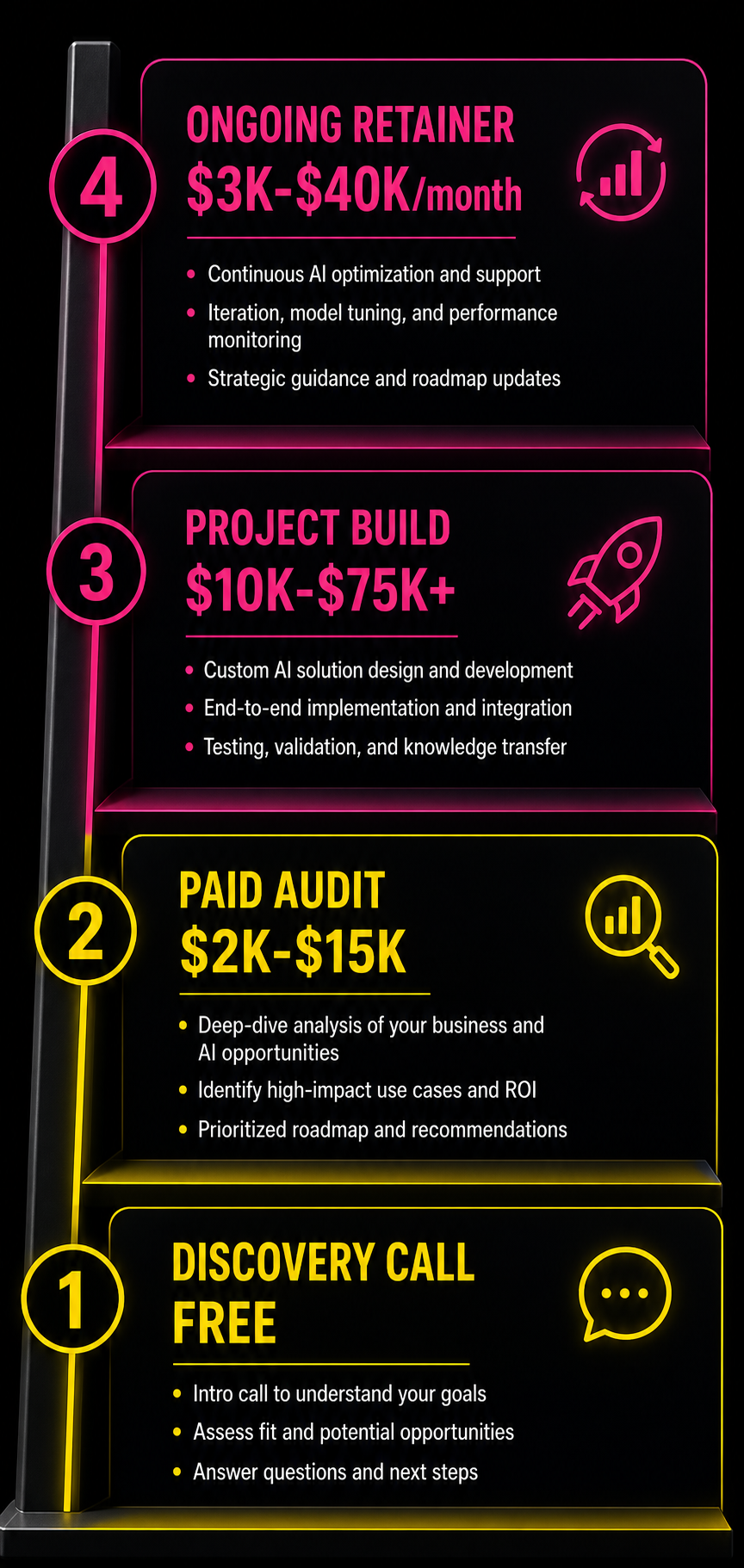
There's no single pricing model in this industry. What you encounter depends on the firm, the scope, and the type of engagement. Here's how each model works in practice.
Hourly Rates: $150 to $500+
Hourly billing is common for advisory work, short assessments, and fractional consulting relationships where you're buying time rather than an outcome.
The range is wide because the market is fragmented. Independent AI consultants with solid track records typically charge $150 to $250 per hour. Boutique firms with specialized teams run $200 to $350 per hour. Big 4 firms (Accenture, Deloitte, PwC, IBM) charge $300 to $600 per hour with minimum engagements that often exceed $100,000.[5]
Geography matters too. West Coast consultants in San Francisco or Seattle average $200 to $400 per hour. Midwest practitioners for comparable work average $100 to $200.[6] Offshore teams in Eastern Europe, India, or Southeast Asia range from $25 to $80 per hour, though the management overhead and time zone coordination cost you back some of that savings.
Hourly is often the wrong model for complex AI work, because it creates perverse incentives. A consultant on hourly rates has no financial motivation to scope tightly or finish fast. I don't love it for anything beyond pure advisory calls or small diagnostic work.
Discovery Calls and Paid Audits: $0 to $15,000
Most consultants offer a free 30-to-60-minute discovery call. That's not consulting, it's sales. What you're buying in that conversation is whether you're a good fit for each other. Don't confuse it with work product.
A paid AI readiness audit or assessment is a different animal entirely. A legitimate audit for a small to mid-sized business should run $2,000 to $8,000 for a narrow engagement scoped to a single workflow, or $5,000 to $15,000 for a more comprehensive assessment covering multiple systems.[7] What you should get for that money:
- A workflow map with time-per-step estimates
- An inventory of your existing tech stack and integration feasibility
- A compliance requirements analysis for your industry
- A prioritized list of automation opportunities ranked by actual ROI potential
- A written implementation roadmap with timeline and cost ranges
- A clear statement of what is in and out of scope for any subsequent build
If an audit doesn't include those six things, you're buying a slide deck, not a deliverable. Some firms apply the audit cost toward the project if you proceed. Ask explicitly whether that's the case.
Project-Based Builds: $5,000 to $75,000+ for SMBs
This is where most small and mid-sized businesses land when they decide to actually build something. The range for SMB-tier projects runs from about $10,000 for a narrow, single-workflow automation up to $75,000 for a full production-ready implementation.[8]
What's actually inside that number:
- Simple workflow automation (a single process, clean data, no integration headaches): $5,000 to $25,000
- Mid-complexity build (2-3 integrated systems, some data prep required, staff training included): $25,000 to $50,000
- Full implementation (multi-system, custom modeling, change management, production deployment, documentation): $50,000 to $75,000+
For enterprise clients, those numbers shift dramatically. Large-scale AI initiatives at enterprise organizations range from $150,000 to over $1,000,000, with some complex transformation projects exceeding that.[9]
Monthly Retainers: $3,000 to $40,000+
Retainers are for ongoing relationships: continued development, monitoring, iteration, and advisory support after the initial build.
For advisory-only retainers (strategy calls, vendor vetting, quarterly planning), expect $3,000 to $5,000 per month for light engagement, $5,000 to $15,000 per month for active advisory with access to a senior consultant on a weekly basis.[10]
Execution retainers, where you're essentially buying a slice of a development team's capacity, run $10,000 to $40,000 per month. These are for organizations that have committed to AI as an ongoing operational priority, not a one-time project.
I'll say this directly: if a consultant is pushing you toward a $15,000-per-month retainer on your first engagement before you've proven a single use case delivers ROI, that's a flag. Start smaller. Prove value. Scale the relationship from there.
What Drives Costs Up
This is the part that surprises most clients, and it's where most budgets get blown. The consulting fees themselves are often not the biggest cost driver.
Undefined Processes
If you don't have documented workflows before we start, we have to build them together. That takes time. Documenting what your team actually does versus what they think they do is a discovery process that can add 20-40% to the initial scope. I've walked into organizations where three people doing the same role had three completely different processes. We had to harmonize all three before we could automate any of them.
If you can hand me documented, current-state process maps before we start, you will spend less money. That's a hard guarantee.
Bad Data
Gartner found that 85% of AI projects fail due to poor data quality or lack of relevant data.[3] I'd add that it's not just quality, it's accessibility and consistency. I've had clients who had years of transaction data that was split across four different systems with different field names, different date formats, and different category taxonomies. Reconciling that was not a small task.
Data preparation and governance are where costs blow out. Organizations that have mature data governance reduce AI implementation costs by 20-35% and accelerate time-to-value by 40-60%.[11] If your data is messy, expect to spend real money cleaning it before any model can touch it.
Legacy Integration Headaches
This one catches people off guard. Systems without APIs require custom integration work that can cost $40,000 to $150,000 per system. Undocumented interfaces that need reverse engineering add $25,000 to $100,000. Incompatible data models requiring complex transformation layer on another $30,000 to $120,000.[12]
If you're running old systems, the AI itself is often the cheapest part of the project. The expensive part is making your existing infrastructure talk to it.
Change Management Weight
Here's the variable that doesn't show up in most proposals but should. Organizational resistance to AI adds 8-15% in additional costs through job displacement fears, skill gaps, process change friction, and the data governance battles that happen internally when people feel threatened.[11]
I've watched a genuinely excellent AI build fail in production because nobody prepared the team for it. The system worked. The people didn't trust it. They routed around it. The budget was wasted not because the technology failed but because the human side wasn't designed.
Change management is not a line item you should let consultants skip to keep the proposal looking lean.
What Drives Costs Down
The good news is that you have real leverage here. Clients who show up prepared spend materially less for the same outcome.
Clear Scope
Scope creep is the silent budget killer in AI projects. 68% of AI projects exceed their initial budget estimates, with the average overrun reaching 42% above the original figure.[13] The primary driver of that overrun is scope that wasn't locked down at the start.
If you walk in knowing exactly which process you want to automate, with a written definition of what "success" looks like, you'll get a tighter proposal and have a much stronger basis for holding the engagement to it.
Good Documentation
I mentioned this above, but it's worth repeating because clients consistently underestimate how much it matters. Handing a consultant documented workflows, data dictionaries, and system diagrams cuts discovery time significantly. That's billable time you're not paying for.
Small Starting Footprint
The clients who get the best outcomes, and spend the least money getting there, are the ones who pick one process, prove it works, and expand from there. The clients who want to boil the ocean on engagement one are the ones who end up with half-built systems and burned budgets.
Start with your highest-pain, cleanest-data process. Get that to production. Measure the ROI. Then use that success to fund the next one.
Modern Infrastructure
If your team is already on a cloud-based tech stack with APIs, CRM, ERP, and data warehousing that's reasonably current, integration work is dramatically cheaper. The investment you've already made in infrastructure modernization pays dividends when AI comes in.
The Hidden Costs Nobody Mentions in the Proposal
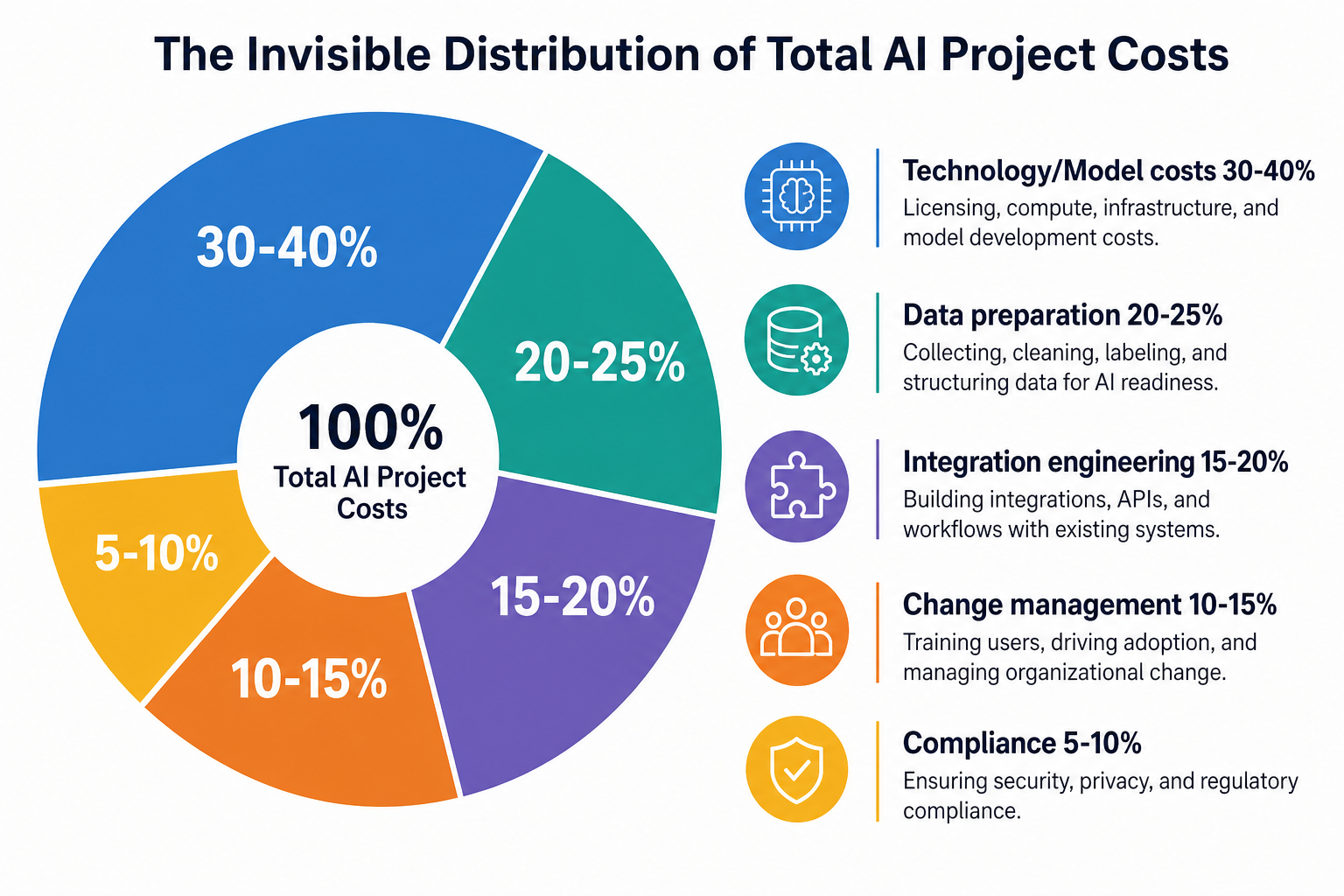
Technology costs represent roughly 30-40% of total AI investment. Implementation, training, and change management comprise the remaining 60-70%.[9] Buyers who focus only on the visible consulting fee are looking at less than half the picture.
Inference Costs
Once an AI system is in production, you're paying ongoing compute costs to run it. For simple workflow automation, this might be a few hundred dollars a month. For generative AI applications with high query volumes, monthly inference bills can reach $20,000 or more.[14] This isn't the consultant's fee. It's what you pay the cloud provider every month forever.
Ask any consultant you're evaluating: "What will this cost me to run in production at our projected volume?" If they don't have an answer, that's a problem.
Monitoring and Maintenance
AI systems drift. Models trained on last year's data perform differently on this year's data. Someone has to monitor this, catch it, and retrain or adjust. Budget 15-20% of the initial build cost per year for ongoing maintenance.
Compliance and Audit Exposure
For regulated industries (healthcare, finance, legal, insurance), AI compliance adds real cost. Organizations spend between $25,000 and $150,000 per audit cycle for AI compliance assessments, depending on system complexity.[12] If you're in a regulated industry and your consultant hasn't raised compliance as a line item, they're either not experienced in your sector or they're hoping you won't ask.
A Worked Engagement: What It Actually Looks Like
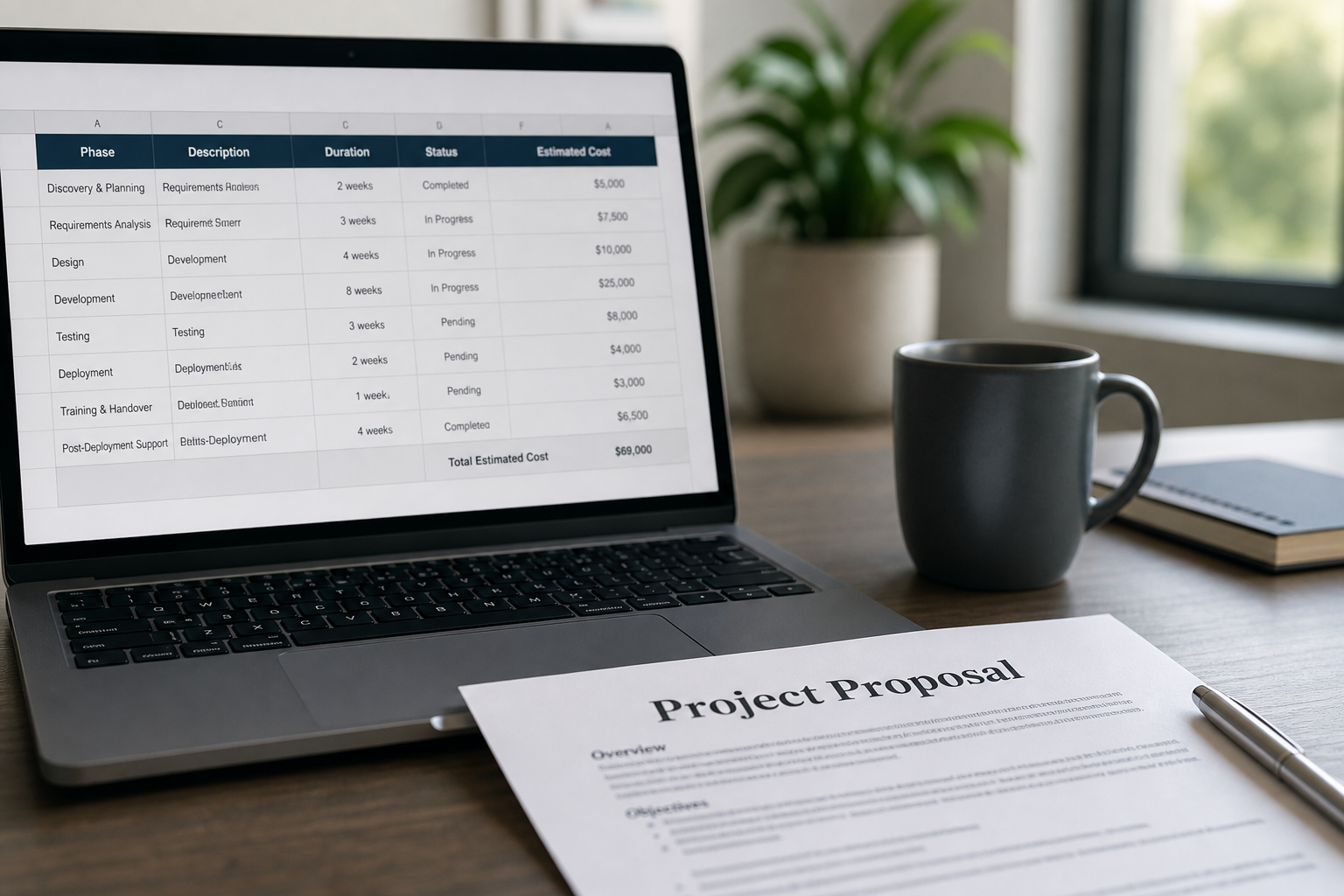
Let me walk through a realistic example to make this concrete.
The client: A regional insurance brokerage with 45 employees. They want to automate their policy renewal follow-up process, which currently has two people spending roughly 60% of their time on manual email and phone outreach.
Phase 1: Discovery Audit ($4,500, fixed fee, 2 weeks)
I come in, map their current workflow, audit their CRM data quality, assess the integration landscape (they're on Salesforce with clean data, which is a good sign), and identify what "automated renewal follow-up" actually needs to do. I deliver a written roadmap with three tiered options at different price points.
Phase 2: Build ($32,000, fixed fee, 8 weeks)
This covers: CRM integration, AI-powered follow-up generation using the client's existing templates and style, automated sequencing logic, a human review queue for edge cases, testing, deployment, and training documentation. The $4,500 audit fee is credited against this.
What it delivers: Two people recapture roughly 60% of their time. At fully loaded cost, that's about $78,000 per year in recovered capacity. The system pays for itself in roughly five months.
Ongoing retainer ($3,500/month)
Monthly monitoring, quarterly model review, Salesforce updates that affect the integration, and 4 hours of advisory. Optional, but recommended in year one.
Total first-year cost: $36,500 build + $42,000 retainer = $78,500
Year-one value from recovered capacity: $78,000+
Breakeven: Month 12, ongoing net positive from month 13 forward
That's not a magic number. That's what a well-scoped, clean-data, single-process engagement looks like when everything goes right. It doesn't always go right. But when the scope is this clean and the data is this tidy, it usually goes close to right.
The Question I Get Asked Most
"Can I just use ChatGPT and skip all of this?"
Sometimes yes. Seriously. If what you need is drafting assistance, email templates, or basic summarization, you don't need a consultant. A $20/month ChatGPT Plus subscription and a few hours of prompt experimentation will serve you fine.
Where you actually need consulting is when the work involves: integrating AI into operational systems, automating multi-step processes, handling sensitive data with compliance requirements, training on proprietary data, or scaling AI across teams with inconsistent workflows.
The failure to distinguish between "AI as a tool I use" and "AI as a system I build" is where most organizations make expensive mistakes. The former is cheap. The latter requires expertise, and expertise costs real money.
My Honest Take
The AI consulting market in 2026 has a lot of practitioners who learned to talk about AI faster than they learned to build with it. You'll encounter proposals with impressive vocabulary and vague deliverables. The tell is usually in what's NOT in the proposal: no change management plan, no data readiness assessment, no defined success metrics, no post-launch support structure.
What you should insist on before signing anything:
- A fixed-fee discovery engagement before any build commitment
- Written deliverables defined for every phase
- A stated definition of "done" that you agreed to, not one the consultant defines unilaterally
- A production cost estimate (inference plus maintenance) as part of the proposal
- References from clients in your industry or a comparable process complexity
AI consulting done right isn't cheap. But it's a lot cheaper than AI consulting done wrong. At Cap Gemini in the 1990s, I watched organizations burn enormous budgets on internet strategy engagements that never delivered because the fundamentals weren't checked at the front: unclear success metrics, no change management plan, no defined scope boundary. AI implementations follow the same failure pattern, often for the same reasons. The technology fails to stick not because it's bad technology but because the organizational groundwork wasn't laid. That organizational trust, once burned, is the hardest thing to rebuild.
If you're evaluating whether AI consulting makes sense for your organization, I'd rather spend 45 minutes helping you figure out if the answer is no than have you commit to a project that wasn't right for you in the first place. That's what a discovery conversation is for.
Sources
[1] Business Research Insights, "Artificial Intelligence (AI) Consulting Market 2026–2035," https://www.businessresearchinsights.com/market-reports/artificial-intelligence-ai-consulting-market-109569, 2026
[2] McKinsey & Company, "The State of AI in 2025: Agents, Innovation, and Transformation," https://www.mckinsey.com/capabilities/quantumblack/our-insights/the-state-of-ai, 2025
[3] Gartner, "Lack of AI-Ready Data Puts AI Projects at Risk," https://www.gartner.com/en/newsroom/press-releases/2025-02-26-lack-of-ai-ready-data-puts-ai-projects-at-risk, 2025
[4] Gartner, "Gartner Predicts 30% of Generative AI Projects Will Be Abandoned After Proof of Concept By End of 2025," https://www.gartner.com/en/newsroom/press-releases/2024-07-29-gartner-predicts-30-percent-of-generative-ai-projects-will-be-abandoned-after-proof-of-concept-by-end-of-2025, 2024
[5] Astrum Software, "AI Consultant Pricing: What Does AI Consulting Cost in 2025?" https://astrum.software/ai-consultant-pricing-what-does-ai-consulting-cost-in-2025, 2025
[6] GroovyWeb, "AI Consultant Hourly Rates 2026: $80–$600/hr by Type," https://www.groovyweb.co/blog/ai-consulting-rates-2026, 2026
[7] Aries Consulting Group, "How Much an AI Readiness Audit Should Cost in 2026," https://ariesconsultinggroup.com/blog/ai-readiness-audit-cost/, 2026
[8] The AI Consulting Network, "AI Consulting for Small Businesses: Cost Guide 2026," https://www.theaiconsultingnetwork.com/blog/ai-consulting-small-businesses-cost-how-it-works, 2026
[9] AppInventiv, "AI Development Cost in 2026: Complete Pricing Guide," https://appinventiv.com/blog/ai-development-cost/, 2026
[10] Layer3 Labs, "AI Consulting Rates and Pricing in 2026," https://www.layer3labs.io/guides/ai-consulting-rates-pricing, 2026
[11] Pertama Partners, "Hidden Costs of AI Implementation," https://www.pertamapartners.com/insights/hidden-costs-ai-implementation, 2025
[12] Xenoss, "Total Cost of Ownership for Enterprise AI: Hidden Costs and ROI Factors," https://xenoss.io/blog/total-cost-of-ownership-for-enterprise-ai, 2025
[13] CIO.com, "AI Cost Overruns Are Adding Up: Major Implications for CIOs," https://www.cio.com/article/4064319/ai-cost-overruns-are-adding-up-with-major-implications-for-cios.html, 2025
[14] CloudZero, "How Much Does AI Cost? The Complete Guide for 2026," https://www.cloudzero.com/blog/how-much-does-ai-cost/, 2026